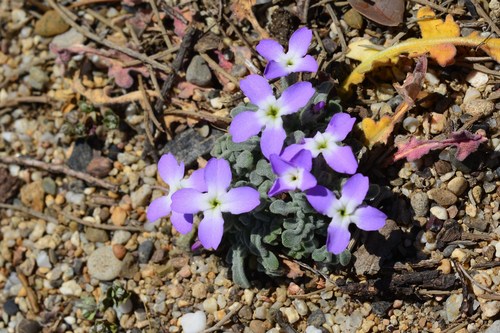
Sea Stock
Matthiola sinuata
A hardy jewel of the shoreline, the Sea Stock thrives where few others can. With its felted silver leaves and intoxicating night-time fragrance, it is the ultimate symbol of coastal resilience.
Quick Identification
Size
Grows between 15 to 60 cm (6 to 24 inches) in height, typically forming a spread of 30 cm (12 inches).
Colors
Pale lilac to deep purple four-petalled flowers; foliage is a distinctive silvery-grey or dusty white.
Key Features
- Four-petalled lilac flowers arranged in a loose spike
- Deeply lobed, wavy-edged lower leaves
- Entire plant covered in dense, soft white hairs and tiny glands
- Long, slender seed pods (siliques) reaching up to 12 cm
When You’ll See Them
Behavior
Sea Stock is a resilient coastal specialist, often behaving as a biennial or short-lived perennial. In its first year, it focuses on survival, developing a low-growing rosette of silver-green leaves that are heavily felted to protect against salt spray and moisture loss. By its second year, it sends up elegant flowering stalks that brave the harsh winds of the maritime environment.
One of the most fascinating aspects of this plant is its relationship with light and scent. While the lilac blooms remain visible throughout the day, they are relatively scentless under the hot sun. As dusk falls, the plant undergoes a metabolic shift, releasing a potent, clove-like fragrance to signal nocturnal pollinators. This 'night-scented' strategy ensures it attracts specialized moths that are active when the coastal winds often die down.
EverydayEarth exclusive
Camera Tips
To capture the true essence of Sea Stock, you need to think low. Position your AI-powered camera on a ground-level spike or a very short tripod, roughly 10 to 15 inches from the base of the plant. Angle the lens upward at a 30-degree tilt; this not only makes the lilac flowers pop against the sky but also highlights the unique 'woolly' texture of the silver leaves which is a key identification feature. If your camera has a macro mode or a close-focus setting, use it to capture the tiny glandular hairs on the stems.
Because Sea Stock is a magnet for pollinators, your camera should be set to its most sensitive motion-trigger setting. During the day, you will likely catch small bees and butterflies, but the real magic happens at twilight. Use an infrared-capable camera or a very low-glow LED to monitor the plant between 8 PM and midnight. This is when the rare Hummingbird Hawk-moth or various Noctuidae moths will visit the fragrant blooms. Set your camera to record 15-second video clips to capture the high-speed wing beats of these visitors.
Coastal environments present unique challenges for trail cameras. Sand and salt can quickly cloud a lens, so check and wipe your camera glass every few days. Since dunes are often windy, tall grasses blowing in the background can trigger hundreds of 'false' videos. Clear a small 2-foot radius of swaying grass around the Sea Stock plant to ensure your AI only triggers when a pollinator arrives or when the plant itself moves significantly.
For a spectacular long-term project, use a time-lapse setting to document the 'bolting' phase. Set the camera to take one photo every 6 hours starting in early May. Over the course of a month, you will see the silver rosette transform into a tall, flowering spike. This provides a fascinating look at how the plant adapts its structure to the shifting coastal environment throughout the spring season.
Similar Species
Species that look similar or are commonly confused with Sea Stock.
Frequently Asked Questions
Record Sea Stock at your habitat
Connect a camera to start building your own species record — AI identifies every visitor automatically.