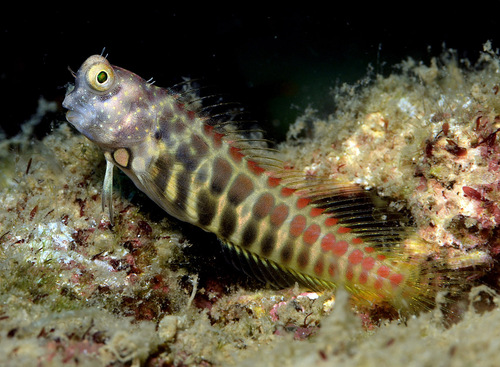
Segmented blenny
Salarias segmentatus
With its quirky personality and striking banded pattern, the Segmented blenny is the busy gardener of the Pacific reefs. This small but bold fish is a favorite for those looking to discover the hidden life of the coral floor.
Quick Identification
Size
Reaches a total length of approximately 11 cm (4.3 in).
Colors
Tan to light brown base color with dark vertical bars or 'segments' along the body; subtle blue speckling often visible on the head and fins.
Key Features
- Distinct dark vertical segments along the flanks
- Blunt, rounded head with large, expressive eyes
- Fringed cirri or 'eyebrows' above each eye
- Comb-like teeth used for grazing on algae
When You’ll See Them
Geographic range
Where Does the Segmented blenny Live?
The Segmented blenny is native to the warm, nutrient-rich waters of the Western Central Pacific. Its core habitat stretches across the Coral Triangle, including the coastal reefs of Indonesia, the Philippines, Palau, and Papua New Guinea, reaching as far east as the Solomon Islands. While it is a common sight for divers in these regions, it remains a resident of shallow, sun-drenched reef environments and does not migrate long distances.
Basemap © OpenStreetMap contributors
Behavior
The Segmented blenny is a charismatic bottom-dweller characterized by its 'hopping' movement. Unlike fish that swim in open water, this species spends most of its time perched on rocky substrates or coral rubble, using its specialized pelvic fins to prop itself up. They are highly territorial over their chosen grazing patches and can often be seen performing quick, darting maneuvers to chase away competitors or retreating into small crevices when threatened.
These fish exhibit a fascinating level of situational awareness, frequently rotating their eyes independently to scan for predators while they feed. While they are generally solitary, they are incredibly industrious, spending the daylight hours meticulously scraping algae from surfaces. In an aquarium or backyard reef pond setting, they are known for their 'personality,' often peering back at observers with apparent curiosity.
EverydayEarth exclusive
Camera Tips
To capture high-quality footage of a Segmented blenny, your camera must be positioned at 'fish-eye' level. Because these blennies stay low to the substrate, a top-down angle will only show their backs and obscure their distinctive segmented patterns. If using an underwater housing or a specialized reef-cam, mount the device just 2 to 3 inches above the seafloor or tank bottom, tilted slightly upward to catch their facial expressions and the movement of their fringed cirri.
Lighting is your best friend when filming this species. Blennies are most active when the sun is high, as the bright light stimulates the growth of the algae they eat. For the best color reproduction, ensure your camera is set to a white balance suitable for shallow water (often a 'cloudy' or 'underwater' setting). If using an AI-powered camera, set the motion trigger to high sensitivity; blennies move in short, rapid bursts that can easily be missed by standard recording triggers.
To attract a Segmented blenny to a specific spot, identify a 'feeding rock'—typically a flat piece of coral rubble or rock that is starting to grow a green film of algae. Place your camera facing this rock from about 12 inches away. Avoid using high-protein fish food as bait, as these fish are strictly herbivores. Instead, moving a fresh, algae-covered rock into their territory will almost certainly trigger an immediate visit from the resident blenny, who will come to investigate and claim the new food source.
Similar Species
Species that look similar or are commonly confused with Segmented blenny.
Frequently Asked Questions
Record Segmented blenny at your habitat
Connect a camera to start building your own species record — AI identifies every visitor automatically.