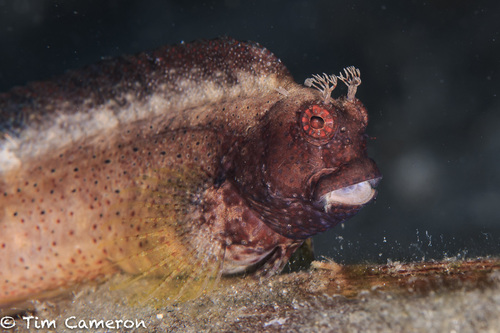
Starry blenny
Salarias ramosus
Decked out in a constellation of white spots, the Starry blenny is the 'rock star' of the shallow reef. These expressive, perching fish are famous for their frog-like eyes and busy, algae-mowing lifestyle.
Quick Identification
Size
Grows to approximately 14 cm (5.5 inches) in total length
Colors
Deep charcoal to chocolate brown body covered in a dense pattern of small, brilliant white or pale blue spots; subtle dark vertical bars may appear on the flanks
Key Features
- Fleshy, branched cirri (tentacles) above the eyes and on the nostrils
- Continuous dorsal fin running the length of the body
- Blunt, rounded head with large, independently moving eyes
- Stocky, eel-like body that tapers toward the tail
When You’ll See Them
Geographic range
Where Does the Starry blenny Live?
The Starry blenny is a tropical specialist found throughout the Western Central Pacific. Its primary range includes the coral-rich waters of the Philippines, Indonesia, and Papua New Guinea, extending down to the northern reaches of Australia's Great Barrier Reef. While it is a staple of these Indo-Pacific archipelagos, it is strictly a marine species and does not venture into brackish or freshwater environments.
Basemap © OpenStreetMap contributors
Behavior
The Starry blenny is a spirited and highly observant bottom-dweller, well-known among marine enthusiasts for its frog-like face and curious personality. Lacking a swim bladder, this species does not swim in open water but instead 'hops' across the substrate using its strong pectoral fins. It spends most of its day perching on high points of coral or rock, swiveling its eyes to monitor for both predators and potential competitors.
While generally peaceful, the Starry blenny is fiercely territorial regarding its grazing rights. It will often exhibit a 'blustery' display toward other blennies, flaring its fins to warn them away from its preferred algae patches. In interactions with humans or larger creatures, they are initially shy, darting into pre-poked holes or crevices in the reef, but they often reappear quickly once they perceive the threat has passed, peeking out with just their heads visible.
EverydayEarth exclusive
Camera Tips
Capturing the Starry blenny on camera requires an understanding of their 'perch-and-pivot' movement. These fish have favorite lookout spots—usually a flat-topped rock or a brain coral head with a clear view of the surrounding area. To get the best footage, place your underwater camera on a weighted mini-tripod just 3-6 inches away from a suspected perch. Aim the lens slightly upward to capture the blenny's profile and its distinctive branched cirri against the water column.
Lighting is your biggest challenge and best friend. The Starry blenny's namesake spots are highly reflective. If you are filming in shallow tide pools or 'backyard' reefs, wait for high-noon sun when light penetrates the water vertically. This makes the white spots pop against their dark bodies. If using artificial lights, use a wide-angle video light with a diffuser to avoid harsh 'hot spots' on the fish's skin, which can blow out the detail of their intricate patterns.
Because they are sensitive to vibrations, a motion-activated camera or a long-range remote trigger is better than holding the camera by hand. Set your camera to a macro or close-up mode with a fast shutter speed; blennies move in quick, jerky bursts. If the fish is hiding, remain still for 5-10 minutes. Their natural curiosity usually gets the better of them, and they will eventually emerge from their hole to inspect the lens, providing an excellent opportunity for a 'face-on' portrait.
Similar Species
Species that look similar or are commonly confused with Starry blenny.
Frequently Asked Questions
Record Starry blenny at your habitat
Connect a camera to start building your own species record — AI identifies every visitor automatically.