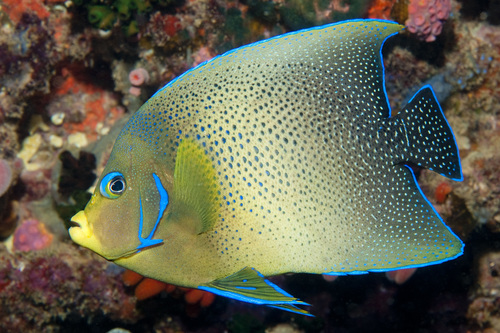
Semicircle Angelfish
Pomacanthus semicirculatus
A master of metamorphosis, the Semicircle Angelfish transforms from a striped sapphire juvenile into a speckled emerald adult. This territorial beauty is a favorite of underwater explorers for its inquisitive nature and stunning neon-blue accents.
Quick Identification
Size
Adults typically reach 35–40 cm (14–16 inches) in length and can weigh up to 1.2 kg (2.6 lbs).
Colors
Juveniles are black with concentric white and electric blue semi-circular stripes; adults are brownish-green with blue speckles and sapphire-blue fin margins.
Key Features
- Dramatic shift from striped juvenile to speckled adult
- Blue sapphire-like edging on the dorsal and anal fins
- Large, curved spine located on the lower preoperculum (gill cover)
- Tall, compressed body shape typical of reef-dwelling angelfish
When You’ll See Them
Behavior
The Semicircle Angelfish is a charismatic and highly territorial resident of the reef. In their youth, they are often found in shallow, protected areas like tide pools or seagrass beds, where their bold stripes help them blend into the shifting shadows of the reef. As they mature, they move into deeper waters, establishing a home range around coral heads and rocky crevices. While they are generally solitary, they are occasionally seen in pairs, particularly during the breeding season.
These fish are known for their 'curious but cautious' personality. They will often approach a stationary camera or diver to investigate, only to dart into a crevice if they feel threatened. They spend the majority of their daylight hours grazing on the reef surface, using their specialized mouths to pick at tough organisms that other fish avoid. They are also known to produce audible 'drumming' or clicking sounds when agitated or defending their territory.
EverydayEarth exclusive
Camera Tips
Capturing the Semicircle Angelfish requires a strategic approach to underwater housing and placement. Because these fish are territorial and habitual, they often follow a specific 'patrol route' around their favorite coral heads. To get the best footage, mount your camera at a slight upward angle near the base of a reef ledge or a large sponge colony. This angle captures the iridescent blue margins of their fins as they swim above, which is their most striking feature in the adult stage.
Lighting is your biggest challenge underwater. If your camera is deeper than 5 meters, the vibrant blues and greens of the Semicircle Angelfish will look muted and gray without an external light source. Use a wide-angle lens with a high-CRI (Color Rendering Index) video light to bring out the 'Koran' patterns on their scales. If you are using an AI-triggered camera, set the motion sensitivity to high, as these fish move with a graceful but somewhat erratic gliding motion that can sometimes be missed by slower sensors.
Maintenance is key for long-term backyard reef setups. Algae growth on the lens port can ruin your shots within days. We recommend using a lens wiper system or applying a specialized hydrophobic coating to the port. If you are trying to attract one to your camera's field of view, look for areas with high sponge density; however, avoid using artificial bait, as it can disrupt their natural grazing behavior and attract unwanted predators that might scare the angelfish away.
Similar Species
Species that look similar or are commonly confused with Semicircle Angelfish.
Frequently Asked Questions
Record Semicircle Angelfish at your habitat
Connect a camera to start building your own species record — AI identifies every visitor automatically.