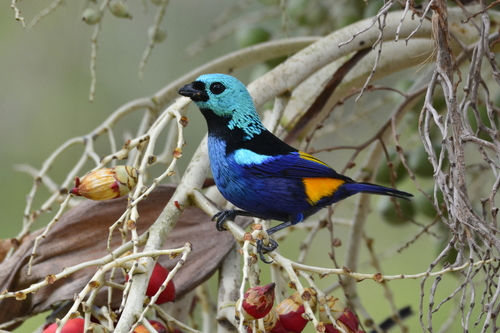
Seven-colored Tanager
Tangara fastuosa
One of South America's most breathtakingly vibrant birds, the Seven-colored Tanager is a living rainbow endemic to the forests of Northeast Brazil. Though vulnerable in the wild, its stunning turquoise, cobalt, and orange plumage makes it a holy grail for backyard birders and wildlife photographers.
Quick Identification
Size
Approximately 13.5 cm (5.3 inches) in length; weight ranges from 22-28 grams (0.8-1.0 ounces).
Colors
A spectacular mix of turquoise-blue on the head, shining cobalt on the breast, vivid orange on the lower back/rump, and black on the upper back and wings. Males and females look nearly identical, though females may appear slightly less vibrant.
Key Features
- Brilliant orange-yellow patch on the lower back and rump
- Deep turquoise-green crown and throat
- Black mask around the eyes and beak
- Intense cobalt blue belly and underparts
When You’ll See Them
Behavior
The Seven-colored Tanager is a high-energy, social bird that is almost constantly on the move. They are typically found in small groups of three to six individuals, often joining mixed-species flocks to forage through the canopy of the Atlantic Forest. Their movement is characterized by quick, acrobatic hops as they glean insects from leaves or reach for small fruits hanging at the tips of branches.
While they are primarily forest dwellers, they are increasingly observed in shaded plantations and suburban gardens near forest fragments. They are not particularly aggressive but are quite wary; they will often visit a feeder only when they feel the coast is clear, darting back into thick foliage at the slightest disturbance. Their vocalizations are thin, high-pitched seeps and trills that can be hard to hear over wind or traffic.
EverydayEarth exclusive
Camera Tips
To capture the stunning palette of the Seven-colored Tanager, camera placement is everything. These birds prefer the mid-to-upper canopy, so mounting your AI camera on a high branch or a specialized tall bird-feeder pole (about 2 to 3 meters off the ground) will yield much better results than ground-level setups. Position the camera with the sun at your back to ensure the light hits their iridescent feathers, as shade can make their brilliant blues and greens look surprisingly dark.
Food is the best lure for this species. They are particularly fond of overripe bananas, papayas, and oranges. Use a platform feeder rather than a tube feeder, as it allows multiple birds to land and creates a better stage for wide-angle captures. If you are in their native range in Northeastern Brazil, planting native fruiting trees like Cecropia or Melastomes near your camera site will provide a natural and consistent draw for them.
Because these tanagers are fast and flighty, set your AI camera to a 'Burst' or 'High Sensitivity' mode. A fast shutter speed is essential to prevent motion blur during their quick hops. If your camera supports it, enable 4K video recording to capture the subtle shifts in their feather colors as they move through different lighting. During the drier months, a shallow, elevated bird bath with a small dripper or mister can be even more effective than food, as the sound of moving water is an irresistible signal for them to bathe and drink.
Finally, consider the background. Because the bird is so colorful, a neutral, out-of-focus green or brown background will make the Seven-colored Tanager 'pop' in your photos. Avoid placing the camera where it points directly at a bright sky, as this will silhouette the bird and lose all the detail in those namesake seven colors.
Similar Species
Species that look similar or are commonly confused with Seven-colored Tanager.
Frequently Asked Questions
Record Seven-colored Tanager at your habitat
Connect a camera to start building your own species record — AI identifies every visitor automatically.