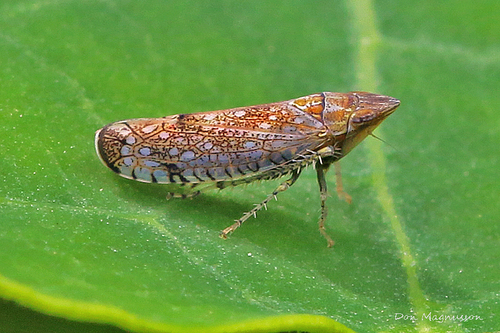
Sharp-nosed Leafhopper
Scaphytopius acutus
The Sharp-nosed Leafhopper is a master of miniature camouflage, featuring a uniquely pointed head and intricate wing patterns that help it blend into the bark and leaves of North American gardens.
Quick Identification
Size
4–5 mm (0.16–0.20 inches) in length
Colors
Mottled brown, tan, and cream with distinctive translucent white spots on the wings and a yellowish-brown head
Key Features
- Distinctly pointed, snout-like head (vertex)
- Mottled brown wings with fine white spotting
- Small, wedge-shaped body
- Rests with wings held roof-like over the back
When You’ll See Them
Geographic range
Where Does the Sharp-nosed Leafhopper Live?
Native to North America, the Sharp-nosed Leafhopper is incredibly widespread across the continent. Its territory spans from southern Canada through the majority of the contiguous United States and into parts of northern Mexico. It is particularly abundant in temperate regions where fruit orchards and ornamental gardens provide a steady supply of host plants.
Basemap © OpenStreetMap contributors
Behavior
The Sharp-nosed Leafhopper is a highly active and agile insect known for its incredible jumping ability. Using powerful hind legs, it can catapult itself several times its body length to escape predators or move between host plants. Like other members of the leafhopper family, it is a phloem-feeder, utilizing specialized piercing-sucking mouthparts to tap into the sap of various plants. They are often found resting on the undersides of leaves or along stems, remaining perfectly still until disturbed.
While largely solitary, these insects are strong fliers and are frequently attracted to artificial lights at night. In agricultural contexts, they are noted as important vectors for plant diseases, such as X-disease in stone fruits. Despite their tiny size, they are fascinating to observe as they move with a characteristic sideways 'crab-like' scuttle when they feel threatened but aren't yet ready to leap away.
EverydayEarth exclusive
Camera Tips
Capturing the Sharp-nosed Leafhopper on camera requires a specialized macro setup because of their diminutive size. Standard backyard trail cameras will likely miss them unless the camera has a very short focal distance or is equipped with a macro lens attachment. To increase your chances, focus your lens on the undersides of leaves or the stems of known host plants like fruit trees or dogwoods. Using a camera with a high-resolution sensor will allow you to crop in and see the intricate mottled patterns on their wings.
One of the most effective ways to 'trap' these insects digitally is by using a light sheet. Set up a white sheet at night with a bright LED or UV light shining on it, and position your camera on a tripod just a few inches from the fabric. Sharp-nosed Leafhoppers are highly attracted to light and will often land on the sheet, providing a stable, high-contrast background for clear identification photos.
Since these insects are extremely sensitive to movement, avoid placing the camera in a way that requires you to approach it frequently. Use a remote shutter or a time-lapse setting (one photo every 30 seconds) to document the visitors to a specific plant. If your camera has a 'pro' mode, use a fast shutter speed (1/250s or higher) to freeze their movement, as they are prone to sudden, lightning-fast hops that can result in a blur.
Similar Species
Species that look similar or are commonly confused with Sharp-nosed Leafhopper.
Frequently Asked Questions
Record Sharp-nosed Leafhopper at your habitat
Connect a camera to start building your own species record — AI identifies every visitor automatically.