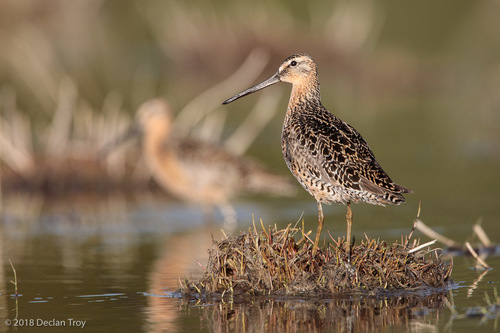
Short-billed Dowitcher
Limnodromus griseus
The 'sewing machine' of the shore, the Short-billed Dowitcher is a marvel of migratory endurance and specialized feeding. Watch as these stocky travelers transform from drab gray to brilliant salmon-orange during their incredible seasonal journeys.
Quick Identification
Size
Length: 25-29 cm (10-11.5 in); Wingspan: 45-51 cm (18-20 in); Weight: 90-155 g (3.2-5.5 oz)
Colors
Breeding adults show mottled brown and gold on the back with salmon-orange underparts; non-breeding plumage is a uniform drab gray. Legs are pale yellow to olive-green.
Key Features
- Extraordinarily long, straight bill used in a vertical 'sewing machine' motion
- White cigar-shaped patch on the lower back, highly visible in flight
- Stocky, hunched profile with relatively short legs compared to other shorebirds
- Densely spotted or barred flanks depending on the subspecies
When You’ll See Them
Behavior
Short-billed Dowitchers are highly social shorebirds, often found in large, dense flocks during migration and winter. They are most famous for their unique feeding style, often described as 'sewing machine' probing. They thrust their long bills vertically into the mud with incredible speed and frequency, feeling for prey using sensitive nerve endings at the bill tip. Unlike many shy shorebirds, dowitchers can be quite approachable if you remain still, allowing for excellent observation opportunities.
During the breeding season, they move to northern bogs and muskegs, but for most of the year, they are birds of the coast. They exhibit strong flocking instincts, often flying in tight formations that twist and turn in unison. While they aren't common backyard visitors in the traditional sense, homeowners living near salt marshes or coastal estuaries will often see them resting on docks or foraging in the mud just beyond the lawn.
EverydayEarth exclusive
Camera Tips
To capture the Short-billed Dowitcher, the most critical factor is camera height. These birds spend almost all their time with their heads down in the mud. To get a professional-looking shot that captures their 'sewing machine' feeding action, mount your camera as low to the ground as possible—ideally just a few inches above the high-tide line. A ground-level perspective creates a beautiful blurred background (bokeh) and brings the viewer into the bird's world.
In coastal settings, timing is everything. Use a tide chart to plan your camera placement. The best footage is usually captured as the tide is rising; as the water covers the mudflats, the birds are pushed closer to the shore and toward your camera. Position your device facing the water in an area where the mud is soft and wet, as this is where they prefer to forage. If you are using a trigger-based trail camera, set it to 'Burst Mode' or high-speed video. Because their head movements are so rapid, a single still photo often ends up with motion blur, but a 3-shot burst increases your chances of catching that perfect moment when the bill is out of the mud.
For those lucky enough to have a backyard bordering a marsh, you can attract them to a specific spot by maintaining a very shallow, muddy edge free of tall vegetation. They prefer wide-open sightlines to stay safe from predators. Avoid using traditional birdseed; instead, focus on preserving the natural mud and avoiding pesticides that kill the invertebrates they rely on. Set your camera's shutter speed to at least 1/1000s if possible to freeze the action of their rapid probing.
Similar Species
Species that look similar or are commonly confused with Short-billed Dowitcher.
Frequently Asked Questions
Record Short-billed Dowitcher at your habitat
Connect a camera to start building your own species record — AI identifies every visitor automatically.