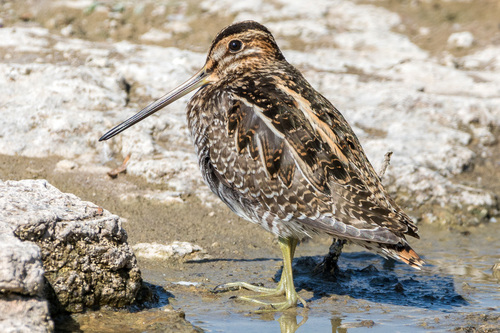
Wilson's Snipe
Gallinago delicata
A secretive shorebird with a bill that acts like a precision tool, the Wilson's Snipe is the ultimate prize for backyard wildlife watchers. Known for its incredible camouflage and haunting aerial displays, it transforms muddy patches into fascinating theaters of hidden life.
Quick Identification
Size
Length: 23–28 cm (9.1–11.0 in); Wingspan: 39–45 cm (15.4–17.7 in); Weight: 79–146 g (2.8–5.1 oz)
Colors
Intricate mottled pattern of brown, black, and cream; pale belly; distinctive buff-colored longitudinal stripes on the head and back; reddish-orange tail tip.
Key Features
- Extremely long, straight bill (approx. 2.5 inches)
- Stocky, short-legged build
- Vertical light stripes running down the back
- Zig-zagging flight pattern when startled
- Dark bars on the flanks
When You’ll See Them
Behavior
The Wilson's Snipe is a master of camouflage, often remaining completely motionless in tall grass or mud until a perceived threat is nearly stepping on it. When they do take flight, they are famous for their rapid, zig-zagging escape path and a sharp, raspy 'scaipe' call. They are generally solitary or found in small, loose groups called 'wisps' during migration and winter.
One of their most fascinating behaviors is 'winnowing,' a courtship display performed by males (and sometimes females). The bird dives through the air, and the wind rushing through its specialized outer tail feathers produces a haunting, tremolo whistling sound. While they are secretive, they can become accustomed to quiet observers if their muddy feeding grounds are left undisturbed.
EverydayEarth exclusive
Camera Tips
To capture high-quality footage of a Wilson's Snipe, your camera must be positioned extremely low to the ground. Aim for a height of just 6 to 12 inches. Because these birds forage by probing the mud, a high angle will miss the fascinating 'sewing machine' motion of their bills. Place your camera at the edge of a muddy puddle or a saturated garden patch where the soil is soft enough to be poked with a finger. If you have a backyard wetland or a low spot that stays soggy after rain, this is your primary target zone.
Since Wilson's Snipe are most active during the 'blue hour' of dawn and dusk, ensure your camera has a high-quality infrared sensor or low-light CMOS sensor. Standard motion triggers can sometimes be fooled by waving reeds, so if your camera allows, use 'Zone' triggering to focus only on the muddy patch. Set your video length to at least 20 seconds; these birds move slowly while foraging, and a short clip might miss the moment they pull a worm from the earth.
While you cannot easily 'bait' a shorebird with birdseed, you can attract them by creating the right conditions. If you have a dry spell, intentionally keeping a small patch of soil saturated with a drip hose can make your yard the only viable feeding ground in the neighborhood. During migration seasons, avoid clearing away dead marsh grasses or leaf litter near your water sources, as the snipe relies on this 'vertical' cover to feel safe enough to emerge from the shadows.
For the best results, use a high-speed SD card and set your camera to its highest frame rate. The sudden 'flush' or take-off of a snipe is incredibly fast, and lower-end cameras will often result in a blurred image of a disappearing tail. If your camera supports audio recording, keep it on! You might catch the unique 'scaipe' call or the distant, eerie sound of winnowing if they are breeding nearby.
Similar Species
Species that look similar or are commonly confused with Wilson's Snipe.
American Woodcock
The Woodcock has horizontal bars on its head rather than vertical stripes and prefers forested uplands over open mudflats.
Long-billed Dowitcher
Dowitchers are more social, often found in larger flocks, and lack the bold buffy stripes on the back seen on the Snipe.
Solitary Sandpiper
The Solitary Sandpiper has a much shorter bill and a prominent white eye-ring, lacking the heavy facial striping of the Snipe.
Frequently Asked Questions
Record Wilson's Snipe at your habitat
Connect a camera to start building your own species record — AI identifies every visitor automatically.