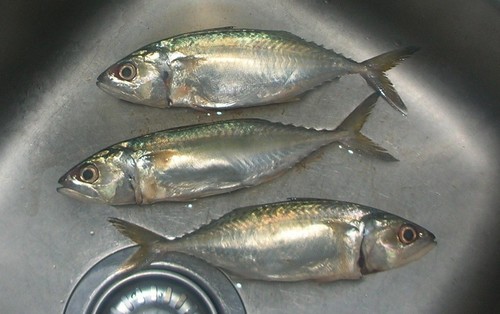
Short Mackerel
Rastrelliger brachysoma
The Short Mackerel is the shimmering heartbeat of Southeast Asian coasts, a deep-bodied speedster that moves in mesmerizing silver schools.
Quick Identification
Size
Typically 15–20 cm (6–8 inches) in length, with a maximum recorded length of 34 cm (13 inches).
Colors
Brilliant silvery sides and belly with a blue-green iridescent back; features two rows of small dark spots along the dorsal midline and a yellowish tail fin.
Key Features
- Distinctively deep, squat body shape (body depth 3.7–4.3 times in length)
- Short, pointed snout with a large eye
- Faint dark longitudinal stripes on the upper back
- Dorsal fin tipped with black
When You’ll See Them
Geographic range
Where Does the Short Mackerel Live?
Native to the tropical waters of the Indo-West Pacific, the Short Mackerel is most abundant throughout the coastal regions of Southeast Asia and Melanesia. Its core range includes the productive waters of Thailand, the Philippines, Indonesia, Malaysia, and Vietnam, extending eastward toward the Solomon Islands and Fiji. These fish are coastal specialists that thrive near river mouths and continental shelves where nutrient-rich runoff supports high plankton density.
Basemap © OpenStreetMap contributors
Behavior
While they are a staple of marine ecosystems, they are also deeply integrated into human coastal life, particularly in Southeast Asia. They are known to be tolerant of human activity and are frequently seen darting around pier pilings, jetties, and moored boats. Their movements are highly seasonal, often dictated by the arrival of monsoon rains which stir up nutrients and trigger plankton blooms, their primary food source.
EverydayEarth exclusive
Camera Tips
Capturing the Short Mackerel on camera requires an underwater approach, as these fish rarely break the surface. If you live on a coastal property or have access to a private dock, the best setup is a submerged action camera or a specialized 'drop-cam' mounted to a pier piling. Position the lens horizontally at a depth of 1 to 2 meters. During an incoming tide, schools often move closer to shore to feed on nutrients pushed in by the current, making this the optimal window for recording.
Because of their brilliant silvery scales, lighting is your biggest challenge. Direct sunlight or heavy underwater flashes can cause 'hot spots' or blown-out reflections on their bodies. For the best results, use ambient light during the 'golden hours' of dawn and dusk. If filming at night, position your LED lights at a 45-degree angle away from the camera lens to minimize backscatter (reflections from particles in the water) and to capture the subtle blue-green iridescence on their backs.
To encourage a school to linger in front of your AI-powered camera, use a scent-based attractant. A mesh 'chum' bag filled with minced shrimp or oily fish scraps hanging just above the camera's field of view will create a localized feeding zone. Since Short Mackerel are fast and move in erratic bursts, set your camera to a high frame rate (at least 60fps) to ensure the AI can clearly identify the deep-bodied silhouette and specific fin markings of the species.
Similar Species
Species that look similar or are commonly confused with Short Mackerel.
Frequently Asked Questions
Record Short Mackerel at your habitat
Connect a camera to start building your own species record — AI identifies every visitor automatically.