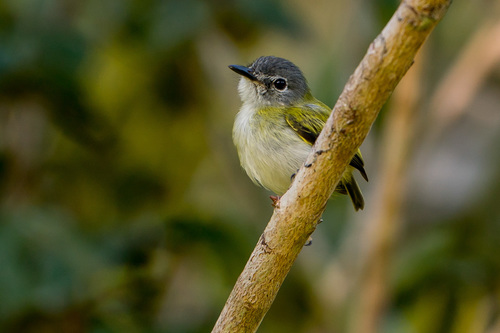
Short-tailed Pygmy-Tyrant
Myiornis ecaudatus
The world's smallest perching bird is a hidden gem of the tropical canopy. Looking more like a large bumblebee than a bird, the Short-tailed Pygmy-Tyrant proves that the most extraordinary wildlife discoveries often come in the smallest packages.
Quick Identification
Size
Length: 6.5-7 cm (2.5-2.8 in); Weight: 4.2-4.8 g (0.15-0.17 oz)
Colors
Olive-green upperparts, gray head with distinct white 'spectacles' around the eyes, white throat, and a pale yellow wash on the belly. Sexes appear identical.
Key Features
- World's smallest perching bird
- Extremely short, almost non-existent tail
- Large-headed appearance with white eye-rings
- Rapid, insect-like wingbeats
When You’ll See Them
Behavior
The Short-tailed Pygmy-Tyrant is a marvel of the avian world, often mistaken for a large beetle or a dragonfly due to its diminutive size and buzzing flight pattern. Unlike many flycatchers that sit stoically on a branch, this species is perpetually in motion, flitting through the mid-to-high canopy with a unique 'gnat-like' energy. They are generally solitary or found in pairs, maintaining small territories through cricket-like trilling calls that are often easier to hear than the bird is to see.
Despite their size, they are surprisingly bold, frequently foraging in the open along forest edges or in clearings. Their social interactions are brief but intense, involving rapid chases through the foliage. For the backyard observer in South America, they rarely visit traditional bird feeders, as they are strictly focused on the hunt for tiny invertebrates, showing little interest in human activity unless a garden provides the perfect micro-habitat of dense, insect-rich shrubbery.
EverydayEarth exclusive
Camera Tips
Capturing the Short-tailed Pygmy-Tyrant on a trail camera is a high-level challenge due to their size and speed. Because they weigh less than a nickel, standard PIR (Passive Infrared) sensors on many budget cameras may fail to trigger. To succeed, use a camera with a 'High' sensitivity setting or, ideally, a device capable of high-frequency time-lapse mode (one photo every 5-10 seconds) during their peak morning activity hours. Position your camera at eye level (about 5-8 feet up) near the edge of a wooded area where the vegetation transitions from dense to open.
Focus is critical for a bird this small. If your camera allows for focal adjustments, set it for a close-range 'macro' zone of 3 to 6 feet. Look for 'song perches'—thin, bare twigs at the end of a branch where a male might sit to vocalize. These perches are your best bet for a clear, still shot. Since they don't eat seeds, you cannot lure them with a standard feeder. However, a fine-mist water dripper or a specialized hummingbird mister can be an irresistible attractant for them to bathe or drink, especially during the dry season.
Lighting is your best friend when filming this species. Because they have dark olive and gray tones, they can easily disappear into the shadows of the canopy. Aim your camera toward the west during morning hours to catch the direct morning sun on their pale bellies. High shutter speeds (1/1000s or faster) are necessary to freeze their rapid wing movements, which can look like a blur even in bright light. If using video, record at 60fps or higher so you can review the footage in slow motion to appreciate their unique hovering behavior.
Similar Species
Species that look similar or are commonly confused with Short-tailed Pygmy-Tyrant.
Frequently Asked Questions
Record Short-tailed Pygmy-Tyrant at your habitat
Connect a camera to start building your own species record — AI identifies every visitor automatically.