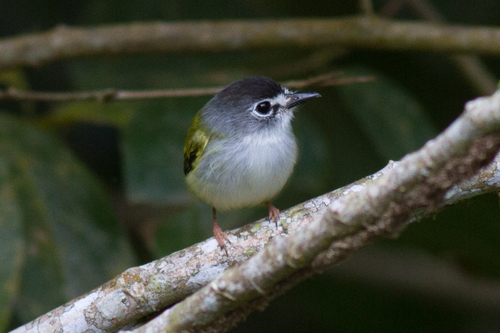
Black-capped Pygmy-Tyrant
Myiornis atricapillus
One of the world's smallest birds, the Black-capped Pygmy-Tyrant is a tiny, energetic wonder of the tropical canopy. With its striking black crown and insect-like movements, it is a master of camouflage and a delight for those lucky enough to spot it.
Quick Identification
Size
Length: 6.5 cm (2.5 in); weight: 5.2 g (0.18 oz)
Colors
Glossy black crown, white spectacles and face, olive-green upperparts, and pale yellow underparts.
Key Features
- Extremely small size, often mistaken for a large insect
- Distinctive black cap contrasting with white eye-rings
- Stubby tail frequently cocked upward
- Rapid, buzzing wingbeats
- Short, straight bill characteristic of flycatchers
When You’ll See Them
Geographic range
Where Does the Black-capped Pygmy-Tyrant Live?
This tiny flycatcher is native to the lush, humid corridors of Central and South America. Its core range begins in the Caribbean lowlands of Costa Rica and extends through Panama, crossing into the Pacific slope of northwestern Colombia and reaching as far south as northwestern Ecuador. It is a dedicated lowland specialist, thriving in the warm, equatorial climate of the Neotropics.
Basemap © OpenStreetMap contributors
Behavior
The Black-capped Pygmy-Tyrant is a marvel of the avian world, holding the title of one of the smallest passerines on Earth. Despite its diminutive stature, this bird is highly energetic and territorial. It typically inhabits the mid-to-upper levels of the forest canopy, where it flits restlessly from twig to twig. Because of its size and speed, it is often more easily identified by its voice—a series of high-pitched, rhythmic 'tick' notes that sound remarkably like a cricket or cicada.
These birds are mostly solitary or found in mated pairs, rarely joining the larger mixed-species foraging flocks common in the tropics. They exhibit a unique 'hover-gleaning' behavior where they momentarily hang in the air to pluck tiny insects from the undersides of leaves. While they are not particularly fearful of humans, their preference for dense foliage and their sheer lack of mass makes them a difficult subject to spot without the aid of high-quality optics or motion-activated cameras.
EverydayEarth exclusive
Camera Tips
Capturing a Black-capped Pygmy-Tyrant on camera is the ultimate challenge for backyard wildlife enthusiasts. Because they are roughly the size of a thumb, standard motion sensors may fail to trigger. To succeed, you must use a camera with high-sensitivity PIR (Passive Infrared) settings or a dedicated 'small animal' mode. Positioning is everything; place your camera 5 to 8 feet off the ground, aimed at thin, horizontal perching twigs near forest gaps or flowering trees that attract small gnats and flies.
Lighting is your best friend when photographing this species. These birds are most active in the mid-canopy where sunlight filters through the leaves. If you can set up near a break in the canopy where a 'light well' hits the understory, your camera will have a much better chance of achieving the fast shutter speed required to freeze their rapid movements. A shutter speed of at least 1/1000s is recommended to avoid motion blur from their insect-like wing beats.
While they don't visit traditional bird feeders, you can entice them by creating a 'micro-habitat' in view of your camera. A shallow, elevated birdbath with a solar-powered dripper or mister is an excellent lure, as these tiny birds need to bathe frequently to maintain their plumage in the humid heat. Ensure the camera is positioned within its minimum focal distance (usually 3-5 feet) to get enough detail to distinguish the bird from the surrounding foliage.
Similar Species
Species that look similar or are commonly confused with Black-capped Pygmy-Tyrant.
Frequently Asked Questions
Record Black-capped Pygmy-Tyrant at your habitat
Connect a camera to start building your own species record — AI identifies every visitor automatically.