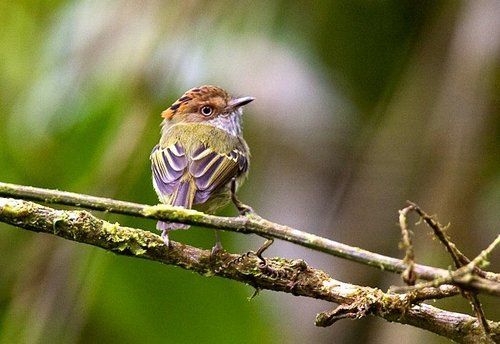
Scale-crested Pygmy-Tyrant
Lophotriccus pileatus
Tiny but full of personality, the Scale-crested Pygmy-Tyrant is a master of the forest undergrowth. Famous for its 'scaled' rufous crest and frantic wing-flicks, this miniature flycatcher is a prized find for any backyard observer in the tropics.
Quick Identification
Size
9-10 cm (3.5-4 in) in length; wingspan of approximately 14 cm (5.5 in); weight 6-8 g (0.2-0.3 oz)
Colors
Olive-green upperparts with dark wings featuring two yellowish wing bars; underparts are pale yellowish-white with faint olive-grey streaking on the breast. The most notable feature is the rufous-brown crest tipped with black, which can be raised or lowered.
Key Features
- Erectile rufous crest with black 'scaled' tips
- Frequent, rapid wing-flicking while perched
- Small, compact frame with a disproportionately large head
- Dull yellow edges on the wing feathers
When You’ll See Them
Behavior
The Scale-crested Pygmy-Tyrant is a high-energy insectivore known for its constant motion and distinctive upright posture. It spends much of its time in the forest understory or mid-story, where it can be seen flicking its wings—often just one at a time—in a nervous, twitchy fashion. While they can be difficult to spot against the green foliage, their vocal nature usually gives them away; they emit a series of dry, clicking trills that pierce through the forest hum.
These birds are generally solitary or found in pairs, rarely joining the large mixed-species foraging flocks common in the American Cordillera. They are highly territorial and will use their namesake crest during social interactions, flaring the feathers to appear larger and more intimidating to rivals. Despite their small size, they are bold and will not hesitate to chase away larger birds from their preferred hunting perches.
EverydayEarth exclusive
Camera Tips
To capture the Scale-crested Pygmy-Tyrant on a trail camera, you must focus on the lower strata of the forest. These birds rarely venture into the high canopy, preferring the shaded understory. Position your camera between 3 and 5 feet (1 to 1.5 meters) off the ground, aiming at thin, horizontal branches that provide a clear line of sight. Look for 'song posts'—specific perches where the bird frequently returns to call; these are goldmines for consistent footage.
Because these birds are incredibly small and fast, your camera's trigger speed is the most critical factor. Aim for a device with a trigger speed of 0.2 seconds or faster. If your camera has a 'Burst Mode' or 'Photo Series' setting, enable it to take at least 3-5 frames per trigger. This increases your chances of catching the bird with its crest fully flared or during its signature wing-flick, which happens in the blink of an eye.
While they don't visit traditional seed feeders, they are highly attracted to moving water in humid environments. A small solar-powered fountain or a dripping mister near a shaded perch can lure them into your camera's frame. If you are setting up a camera in a garden or backyard near a forest edge, planting native shrubs like Melastomes will attract the small insects they prey upon, naturally bringing the birds into range.
Lighting is another key consideration. The understory is often dark, so a camera with a high-quality CMOS sensor that handles low light without excessive noise is ideal. Avoid using a heavy flash, which might wash out the subtle textures of their 'scaled' crest. Instead, try to position the camera where it can benefit from filtered morning light, which highlights the rufous tones in their feathers beautifully.
Similar Species
Species that look similar or are commonly confused with Scale-crested Pygmy-Tyrant.
Pale-eyed Pygmy-Tyrant
Lacks the rufous crest and has a distinct white iris compared to the dark eye of the Scale-crested.
Black-capped Pygmy-Tyrant
Has a solid black crown rather than a rufous, scaled crest and prefers lower elevations.
Common Tody-Flycatcher
Has a much longer, flatter bill and a black-and-yellow face pattern without a prominent crest.
Frequently Asked Questions
Record Scale-crested Pygmy-Tyrant at your habitat
Connect a camera to start building your own species record — AI identifies every visitor automatically.