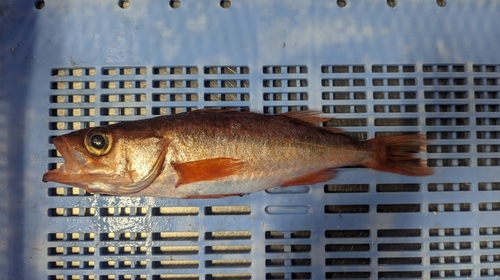
Shortbelly Rockfish
Sebastes jordani
The Shortbelly Rockfish is a slender, schooling marvel of the Pacific depths, serving as the essential 'bread and butter' for the ocean's greatest predators.
Quick Identification
Size
Small for a rockfish, typically reaching lengths of 25–32 cm (10–12.6 inches) and weighing up to 0.4 kg (0.9 lbs).
Colors
Olive-pink to reddish on the dorsal side, transitioning to a silvery-white or pale pink on the belly; no prominent dark blotches.
Key Features
- Slender, elongated body profile
- Anal fin set significantly further back than other rockfish
- Large eyes relative to head size
- Deeply forked tail fin
When You’ll See Them
Geographic range
Where Does the Shortbelly Rockfish Live?
Native to the Eastern Pacific Ocean, the Shortbelly Rockfish is found along the western coast of North America. Its range spans from the chilly waters of the Gulf of Alaska in the north, southward through British Columbia, and down to central Baja California, Mexico. They are most densely concentrated in the nutrient-rich upwelling zones off the coast of Central and Northern California.
Basemap © OpenStreetMap contributors
Behavior
The Shortbelly Rockfish is a highly social, schooling species that distinguishes itself from its more sedentary, reef-dwelling cousins. Unlike many rockfish that prefer to hide in crevices, shortbellies are semi-pelagic, moving in massive midwater aggregations. They are known to participate in diel vertical migration, rising toward the surface at night to feed on plankton and descending to deeper, cooler waters during the daylight hours to avoid predators.
These fish serve as a critical "forage fish" within the California Current ecosystem. Because of their abundance and small size, they are a primary food source for a variety of marine life, including Chinook salmon, harbor seals, and various seabirds like the Common Murre. They are generally not the target of commercial fisheries due to their small size, but their ecological importance cannot be overstated.
EverydayEarth exclusive
Camera Tips
Capturing the Shortbelly Rockfish requires specialized underwater equipment, as they rarely venture into shallow tide pools. If you are using a remote-operated vehicle (ROV) or a deep-drop camera housing, focus your efforts on the edges of the continental shelf or near underwater pinnacles. Because they school in the thousands, a wide-angle lens is essential to capture the scale of their movement.
Since light fades rapidly below 50 meters, high-powered external LED arrays are a must. The Shortbelly's olive-pink hue is often washed out in deep water, appearing grey; artificial light will bring out their true colors. Position your lights at an angle to the camera lens to minimize 'backscatter' from the plankton-rich water they inhabit.
For the best results, use a high frame rate (60fps or higher). Shortbelly Rockfish are fast and twitchy swimmers compared to other Sebastes species. Catching the synchronized movement of a school as they dart away from a predator—or your camera—creates the most compelling footage. If you are stationary, a small mesh bag of crushed krill or fish oil can act as an effective lure to bring the school into the center of your frame.
Similar Species
Species that look similar or are commonly confused with Shortbelly Rockfish.
Frequently Asked Questions
Record Shortbelly Rockfish at your habitat
Connect a camera to start building your own species record — AI identifies every visitor automatically.