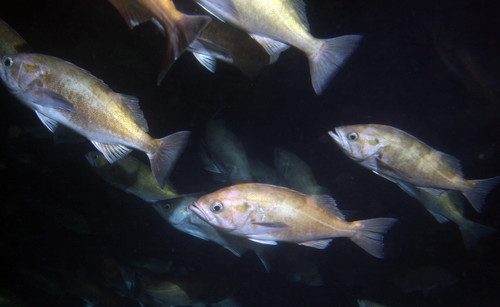
Widow Rockfish
Sebastes entomelas
A master of the midwater, the Widow Rockfish is a brassy-colored socialite of the Pacific's deep rocky reefs. Once a symbol of conservation concern, this resilient species has made a remarkable comeback, now seen in massive schools that shimmer in the deep coastal currents.
Quick Identification
Size
Typically 35-50 cm (14-20 inches), reaching a maximum of 60 cm (24 inches); weight up to 3.3 kg (7.3 lbs)
Colors
Brassy to brownish-black upper body fading to a creamy white or pale belly; fins are usually dark with a possible yellowish tint in juveniles
Key Features
- Brassy-brown to blackish coloration
- Large, dark spot on the operculum (gill cover)
- Relatively small mouth for a rockfish
- Large schools often found suspended in midwater
- Anal fin has a strong posterior slant
When You’ll See Them
Geographic range
Where Does the Widow Rockfish Live?
The Widow Rockfish is native to the cold, temperate waters of the Northeastern Pacific Ocean. Its range begins in the north near the Albatross Bank in the Gulf of Alaska and extends southward along the coastlines of British Columbia, Washington, Oregon, and California. The population reaches its southern limit in the northern waters of Baja California, Mexico, though they are most abundant in the deep reefs off the coast of Central Oregon and Northern California.
Basemap © OpenStreetMap contributors
Behavior
The Widow Rockfish is a highly social species, known for forming massive, dense schools in the midwater column. Unlike many of its cousins that prefer to sit directly on the seafloor, the Widow Rockfish—often called the 'brown bomber'—spends much of its time hovering above rocky reefs and pinnacles. They are semi-pelagic, meaning they move between the bottom and the open water to follow nutrient-rich currents and plankton blooms.
These fish are remarkably long-lived, with some individuals reaching over 60 years of age. They exhibit a slow growth rate and late maturity, which historically made them vulnerable to overfishing. In a social context, their schooling behavior serves as a primary defense mechanism against larger predators like sharks and sea lions, as the 'shimmer' of hundreds of brassy bodies makes it difficult for a predator to target a single individual.
EverydayEarth exclusive
Camera Tips
To capture the Widow Rockfish on a trail camera, you will need a specialized underwater housing capable of withstanding the pressure of at least 30 to 50 meters of depth, even for sub-adults. Focus your camera placement near underwater 'pinnacles' or the edges of steep rocky drop-offs. These are high-traffic areas where currents push plankton upward, attracting large schools of rockfish. Because natural light fades quickly at these depths, high-quality waterproof LED arrays are essential for a clear image.
When setting up your camera, consider a 'lander' configuration—a weighted frame that sits on the bottom with the camera angled slightly upward towards the water column. Since Widow Rockfish are midwater schoolers, looking 'up' toward the surface often allows you to capture their silhouettes and brassy scales against the dim light from above. To attract them into the frame, use a perforated bait canister filled with oily sardines or squid; the scent trail will draw them in from the surrounding reef.
For the best AI detection and video quality, set your camera to a higher frame rate (60fps) if possible, as the schooling movement can be quite fluid and fast. If you are using a motion-triggered system, ensure the sensitivity is tuned to ignore floating 'marine snow' (organic debris) while still catching the distinct shape of a passing fish. Because they are social, once you see one Widow Rockfish on camera, you are likely to see dozens more follow shortly after.
Similar Species
Species that look similar or are commonly confused with Widow Rockfish.
Yellowtail Rockfish
Has much brighter yellow fins and a more squared-off anal fin compared to the Widow's slanted one.
Black Rockfish
Features a much larger mouth that extends past the eye and lacks the brassy-brown sheen of the Widow.
Blue Rockfish
Distinguished by a blue-grey mottled pattern and smaller scales, usually found in shallower water.
Frequently Asked Questions
Record Widow Rockfish at your habitat
Connect a camera to start building your own species record — AI identifies every visitor automatically.