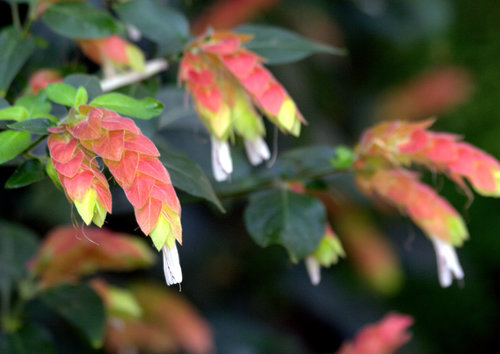
Shrimp plant
Justicia brandegeeana
Named for its striking resemblance to a swimming crustacean, the Shrimp plant is a tropical wonder. Its vibrant red bracts serve as a natural neon sign for hummingbirds, making it the ultimate centerpiece for any wildlife-friendly garden.
Quick Identification
Size
Grows 3-5 feet (0.9-1.5 meters) tall and wide
Colors
Bracts are copper-red, pink, or lime yellow; flowers are white with tiny purple spots on the throat
Key Features
- Overlapping bracts resembling a shrimp's tail
- Small white tubular flowers emerging from the tip of bracts
- Soft, oval-shaped green leaves with a slightly fuzzy texture
When You’ll See Them
Geographic range
Where Does the Shrimp plant Live?
Native to the sun-drenched landscapes of Mexico, the Shrimp plant is a staple of tropical and subtropical environments. It has successfully naturalized across various parts of Florida and the Gulf Coast in the United States, where the warm, humid air mimics its ancestral home. Beyond North America, this resilient shrub has been introduced to many tropical regions throughout Central and South America, often escaping cultivation to grow along forest margins and in disturbed urban areas.
Basemap © OpenStreetMap contributors
Behavior
Justicia brandegeeana, commonly known as the Shrimp plant, is a hardy evergreen shrub that is primarily known for its unique, drooping flower spikes. While it is a stationary plant, it plays a highly active role in the backyard ecosystem as a primary nectar source. It grows in a sprawling, somewhat leggy habit, often creating a dense thicket that provides low-level cover for small reptiles and ground-foraging birds. In warmer climates, it can bloom almost continuously throughout the year.
This plant exhibits a fascinating evolutionary strategy to attract specific pollinators. The colorful bracts are not actually the flowers, but modified leaves designed to protect the delicate white flowers inside and catch the eye of hummingbirds from a distance. Because it is relatively drought-tolerant once established, it is a frequent resident of low-maintenance xeriscapes and pollinator-focused gardens, where it interacts with humans as a visually striking ornamental.
EverydayEarth exclusive
Camera Tips
To capture the best action around a Shrimp plant, mount your camera on a tripod or stake at a height of approximately 3 feet, positioning it level with the most vibrant bract clusters. Since the main attraction here is the hummingbird, you want to focus on the 'business end' of the plant—the white tubular flowers protruding from the red bracts. Use a side-profile angle to ensure you capture the full length of a bird's beak as it enters the flower.
Lighting is the most critical factor for this species. Position your camera so that the sun is behind it (facing the plant) during the morning or late afternoon. This front-lighting will make the copper and red tones of the bracts pop and will allow for a faster shutter speed to freeze the motion of visiting pollinators. If your camera has a high-speed video mode (60fps or higher), use it to capture the rapid wing beats of hummingbirds in slow motion.
Because the Shrimp plant's branches are relatively thin, they tend to sway significantly in the wind. To avoid hundreds of 'false triggers' on a motion-activated camera, try to shield the plant from the wind or adjust your camera's motion zones to exclude the very edges of the branches. Using a camera with a 'Pre-Roll' feature is ideal, as it will capture the split second before a hummingbird enters the frame, which is often missed by standard motion sensors.
Similar Species
Species that look similar or are commonly confused with Shrimp plant.
Frequently Asked Questions
Record Shrimp plant at your habitat
Connect a camera to start building your own species record — AI identifies every visitor automatically.