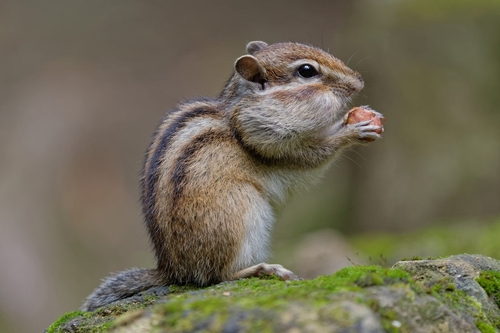
Siberian Chipmunk
Eutamias sibiricus
The only chipmunk native to the Old World, the Siberian Chipmunk is a master of the forest floor, known for its iconic racing stripes and tireless food-gathering missions.
Quick Identification
Size
Body length 12–17 cm (4.7–6.7 in), tail 8–15 cm (3.1–5.9 in), weight 50–120 g (1.8–4.2 oz)
Colors
Reddish-brown or tan upperparts with five dark brown-to-black stripes and four light stripes; creamy white underparts
Key Features
- Five prominent dark longitudinal stripes on back and sides
- Long, bushy tail approximately half the body length
- Distinct facial stripes through and below the eyes
- Internal cheek pouches for transporting large amounts of food
- Small, rounded ears with white patches behind them
When You’ll See Them
Geographic range
Where Does the Siberian Chipmunk Live?
Native to the vast, chilly landscapes of Northern Asia, the Siberian Chipmunk’s heartland stretches from central Russia and the Ural Mountains through Mongolia, northern China, and the Korean Peninsula, reaching as far east as Hokkaidō in Japan. This resilient species is famously the only chipmunk native to the Old World, thriving in the rugged taiga and temperate forests of the east. Interestingly, it has also established thriving introduced populations across Europe—specifically in France, Belgium, Germany, and Italy—following its popularity in the 1960s pet trade, making it a common sight in many European urban parks today.
Basemap © OpenStreetMap contributors
Behavior
The Siberian Chipmunk is a highly energetic, diurnal rodent that spends most of its day foraging on the ground, though it is an exceptionally agile climber. Unlike many other small mammals, they are solitary and maintain individual home ranges, though these may overlap. They are famous for their 'larder-hoarding' behavior, where they spend the autumn months obsessively collecting seeds and nuts in their large cheek pouches to stock underground burrows for the winter.
While they are generally wary of predators, they can become quite bold in suburban settings or parks where they have grown accustomed to human presence. When threatened, they emit a sharp, bird-like 'chip' alarm call to warn others. They are true hibernators, disappearing into their complex burrow systems from late October until the first thaws of March or April, depending on the local climate.
EverydayEarth exclusive
Camera Tips
To capture high-quality footage of Siberian Chipmunks, camera placement is everything. These rodents are primarily ground-dwellers, so position your AI-powered camera very low to the ground—ideally between 6 and 12 inches high. Look for 'highways' such as fallen logs, stone walls, or the base of large trees where they feel secure. Angling the camera slightly downward toward a flat spot near cover will ensure you catch them as they pause to scan for predators.
Because chipmunks are incredibly fast, set your camera to its highest trigger speed and use a short 'retrigger' interval. If your camera supports it, a high-frame-rate video mode is better than still photos, as it captures the frantic, jerky movements that characterize their behavior. If you are using a camera with a fixed focus, try to place it about 3 to 5 feet away from the target area to ensure the animal remains sharp in the frame; any closer and they may appear as a striped blur.
Luring them into the frame is relatively simple with the right treats. A small pile of black oil sunflower seeds, unsalted peanuts, or a smear of peanut butter on a log will almost certainly stop a passing chipmunk in its tracks. For the most natural-looking shots, tuck the bait into a hollow in a log or hide it behind a rock so the chipmunk appears to be foraging naturally in the video. Since they hibernate, focus your efforts during the peak 'caching' season in September and October when they are most active and desperate for food.
Similar Species
Species that look similar or are commonly confused with Siberian Chipmunk.
Frequently Asked Questions
Record Siberian Chipmunk at your habitat
Connect a camera to start building your own species record — AI identifies every visitor automatically.