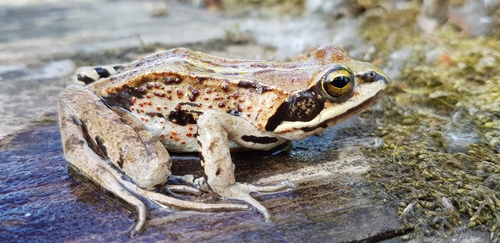
Siberian Wood Frog
Rana amurensis
A champion of the cold, the Siberian Wood Frog is a master of survival in the north. Its striking orange belly and masked face make it a prize find for any backyard nature photographer.
Quick Identification
Size
2 to 3 inches (5–8 cm) in length; weighs approximately 0.5 to 1 oz (15–30g)
Colors
Brown, olive, or tan back with dark speckling; features a signature dark 'mask' behind the eyes and a vibrant orange or reddish-orange underside on the belly and legs.
Key Features
- Distinctive dark brown 'mask' from the snout through the eye
- Vivid orange or reddish coloration on the belly and inner thighs
- Smooth, moist skin with two prominent ridges running down the back
- Relatively short hind legs compared to other wood frogs
When You’ll See Them
Behavior
The Siberian Wood Frog is one of the most cold-tolerant amphibians on Earth, often emerging from hibernation while ice still clings to the edges of ponds. These frogs possess a unique biological 'antifreeze' that allows them to survive partial freezing during the harsh Siberian winters. They are generally solitary and secretive, spending most of their time foraging through damp leaf litter or resting near the water's edge.
During the breeding season in early spring, males congregate in shallow, still waters to produce a subtle, rhythmic clucking call. Unlike many other frog species that are highly vocal, the Siberian Wood Frog's song is relatively quiet. They are primarily terrestrial but require high humidity to stay hydrated, making them very sensitive to dry weather. When startled, they use their powerful hind legs to make several quick, erratic leaps toward cover.
EverydayEarth exclusive
Camera Tips
Capturing high-quality footage of a Siberian Wood Frog requires a 'low and slow' approach. Because these frogs are small and live on the forest floor, your camera must be mounted no higher than 3 to 5 inches off the ground. A specialized ground-stake mount or even a weighted beanbag is perfect for this. Aim the camera horizontally or at a very slight downward angle to capture the frog's profile and its distinctive facial mask.
To increase your chances of a sighting, place your camera near 'high-traffic' areas like the edge of a backyard pond, a damp drainage ditch, or under the shade of hostas and ferns. These frogs are drawn to moisture, so setting up your gear near a leaky outdoor faucet or a dedicated toad abode can yield great results. Using a camera with a high-resolution sensor is vital, as it allows you to crop the image later to see the fine details of their skin texture and orange belly.
Trigger speed is the most critical setting for amphibians. Set your camera to its fastest possible trigger mode (0.2 seconds or less if possible) and use a 'Photo + Video' burst setting. Frogs often sit perfectly still for long periods and then move in a flash; a burst of photos followed by a 10-second video clip ensures you catch the initial jump and the subsequent movement. Since they are active during the day, you don't need to worry much about flash, but a camera with a good macro-focusing range will prevent the images from being blurry at close distances.
During the peak breeding months of March and April, focus your efforts on shallow, sun-warmed pools. Look for the presence of egg masses—small, clear gelatinous clumps—and point your camera at the logs or rocks immediately surrounding them. This is when the frogs are least wary and most likely to stay in one spot for an extended period, allowing for beautiful, clear captures.
Similar Species
Species that look similar or are commonly confused with Siberian Wood Frog.
Frequently Asked Questions
Record Siberian Wood Frog at your habitat
Connect a camera to start building your own species record — AI identifies every visitor automatically.