Silver Sage
Salvia argentea
With its shimmering, velvet-soft leaves and architectural flower spikes, Silver Sage is the Mediterranean's most tactile treasure. A magnet for pollinators and a master of drought-resistance, this plant turns any rocky garden into a silver sanctuary.
Quick Identification
Size
Basal rosettes reach 60–90 cm (2–3 ft) in diameter; flower stalks stand 60–90 cm (2–3 ft) tall.
Colors
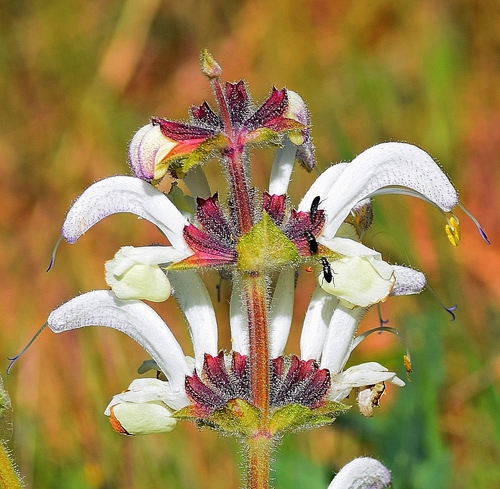
Shimmering silvery-white foliage; flowers are white or pale cream, occasionally tinged with yellow or lavender.
Key Features
- Giant, woolly silver-white basal rosettes
- Velvety leaf texture covered in dense downy hairs
- Multi-branched 'candelabra' flowering stalks
- Deeply lobed, scalloped leaf margins
- Small, white two-lipped flowers in late spring
When You’ll See Them
Geographic range
Where Does the Silver Sage Live?
Silver Sage is native to the sun-soaked regions of Southern Europe and the Mediterranean basin, with a range extending from Portugal and Spain eastward to Bulgaria and Greece. Its native territory also encompasses parts of North Africa, including Morocco and Tunisia, and stretches into Western Asia across the rocky landscapes of Turkey. While it is widely cultivated in temperate gardens across North America and Australia for its striking foliage, it remains most at home in the dry, alkaline soils of its ancestral Mediterranean home.
Basemap © OpenStreetMap contributors
Behavior
Salvia argentea, commonly known as Silver Sage, is a biennial or short-lived perennial that is famous for its architectural foliage. In its first year, the plant focuses entirely on growing a massive, low-lying rosette of leaves. These leaves are covered in a dense, woolly fur that acts as a natural sunscreen and moisture-trap, allowing the plant to thrive in harsh, sun-drenched Mediterranean climates where other plants might wither.
During its second year, the plant undergoes a dramatic transformation, sending up thick, sticky flower stalks that branch out in a distinct candelabra shape. While the flowers themselves are relatively small compared to the massive leaves, they produce copious amounts of nectar. This makes the Silver Sage a social hub in the garden, attracting a constant stream of bumblebees, honeybees, and butterflies during the daylight hours.
EverydayEarth exclusive
Camera Tips
Capturing the beauty of Silver Sage requires a dual strategy: focusing on the unique texture of the leaves and the fast-moving pollinators the flowers attract. For the iconic basal rosette, place your camera at a very low 'worm’s eye' view, about 6 to 10 inches off the ground. Angle the lens slightly upward to emphasize the scale and velvety texture of the leaves. Use a macro lens or a close-focus setting if available, as the fine silver hairs look spectacular in high-definition detail.
To capture the wildlife that visits the plant, move your camera higher (about 2-3 feet) once the flower spikes emerge in late spring. Point the camera at the 'candelabra' branches where the white flowers are most concentrated. Because bees and butterflies move quickly, set your AI camera to 'Photo' or 'Burst' mode with a high shutter speed. This will help you freeze the action of a Hummingbird Hawk-moth or a Carpenter Bee mid-sip.
Lighting is crucial for this species. The silver leaves are highly reflective, which can 'blow out' or overexpose your images in direct midday sun. The best footage is captured during the 'golden hour'—shortly after sunrise or before sunset—when the low-angle light makes the silver hairs glow without creating harsh glares. If your camera has adjustable exposure, consider turning it down slightly to preserve the detail in the white foliage.
Finally, don't ignore the night. While the plant doesn't move, its bright silver foliage reflects moonlight beautifully. Using a camera with high-quality night vision or a soft infrared flash can produce hauntingly beautiful images of the plant against a dark background, and you may even catch nocturnal visitors like moths or curious small mammals sniffing around the base.
Similar Species
Species that look similar or are commonly confused with Silver Sage.
Frequently Asked Questions
Record Silver Sage at your habitat
Connect a camera to start building your own species record — AI identifies every visitor automatically.