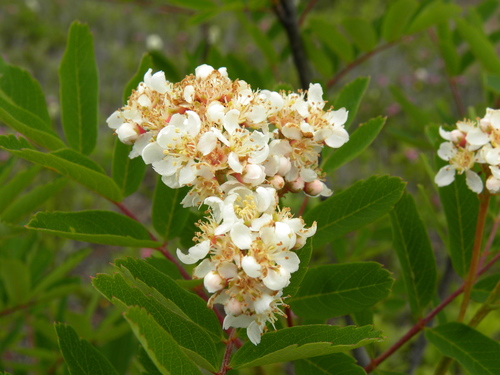
Sitka Mountain-Ash
Sorbus sitchensis
With its brilliant red-orange berries and delicate white blossoms, the Sitka Mountain-Ash is more than just a beautiful shrub—it’s a bustling hub for high-altitude wildlife. From hungry bears to nomadic waxwings, this Pacific Northwest native is a must-have for any backyard nature enthusiast.
Quick Identification
Size
Typically 1–4 meters (3–13 feet) tall; can occasionally reach 6 meters (20 feet) as a small tree.
Colors
Dark green foliage, creamy white flower clusters, and glossy bright red to orange-red berries; bark is smooth and gray.
Key Features
- Compound leaves with 7–11 serrated leaflets
- Dense, rounded clusters (corymbs) of small white flowers
- Glossy, bright red-orange berries in late summer
- Shrub-like growth habit with smooth gray bark
- Leaflets are blunt or rounded at the tips
When You’ll See Them
Geographic range
Where Does the Sitka Mountain-Ash Live?
Native to the rugged landscapes of northwestern North America, the Sitka Mountain-Ash thrives in the cool, moist environments of the Pacific Northwest. Its core range extends from the coastal islands of Alaska and British Columbia southward through the Cascade and Olympic Mountains into northern California, reaching as far east as the Rocky Mountains in Montana and Idaho. This hardy shrub is a staple of subalpine meadows and forest edges, where it marks the transition from dense timber to open mountain vistas.
Basemap © OpenStreetMap contributors
Behavior
The Sitka Mountain-Ash is a cornerstone of subalpine ecosystems, acting as a vital food source for a variety of high-altitude wildlife. While it does not move like an animal, it follows a rigorous seasonal cycle: exploding into white, pungent blooms in early summer to attract pollinators, followed by a heavy fruit set that persists into the colder months. Its growth habit is often multi-stemmed and spreading, creating thickets that provide excellent nesting cover for mountain-dwelling birds and small mammals.
In late summer and autumn, the shrub becomes a focal point of intense animal activity. The high-energy berries are a critical resource for migratory birds and mammals preparing for winter or hibernation. While the plant is hardy and survives in harsh, wind-swept environments, it is most prolific in moist, well-drained soil where it can form dense colonies. In a garden setting, it is a low-maintenance choice that reliably draws a crowd of feathered visitors throughout the fall.
EverydayEarth exclusive
Camera Tips
To capture the wildlife attracted to your Sitka Mountain-Ash, place your camera roughly 3 to 5 feet from a heavy cluster of berries. Since this shrub is a magnet for birds like Cedar Waxwings, Varied Thrushes, and Pine Grosbeaks, a slightly downward angle from a nearby branch or fence post works best to capture the top of the berry clusters where birds prefer to land. If you are in a more remote area, keep the camera level at about 3 feet to catch American Black Bears, which are known to bend branches down to reach the fruit.
Timing is everything with this species. While the flowers are beautiful in June and July, the peak 'action' occurs from late August through October when the berries ripen. Set your camera to a multi-shot burst mode or a short video trigger (10-15 seconds); birds feeding on mountain-ash move quickly and erratically, so a single still photo often misses the best interactions. Use a high shutter speed if your camera allows, as the high-altitude light can be bright and bird movement is fast.
For those using AI-powered cameras, the Sitka Mountain-Ash provides a perfect static background. Avoid placing the camera where long, thin branches will blow directly in front of the lens in high winds, as this may trigger false positives. Instead, find a sturdy main trunk or use an external stake. If you are looking to attract specific mammals, ensure the area around the base of the shrub is clear, allowing the camera a wide field of view to capture animals foraging for fallen fruit.
Similar Species
Species that look similar or are commonly confused with Sitka Mountain-Ash.
Frequently Asked Questions
Record Sitka Mountain-Ash at your habitat
Connect a camera to start building your own species record — AI identifies every visitor automatically.