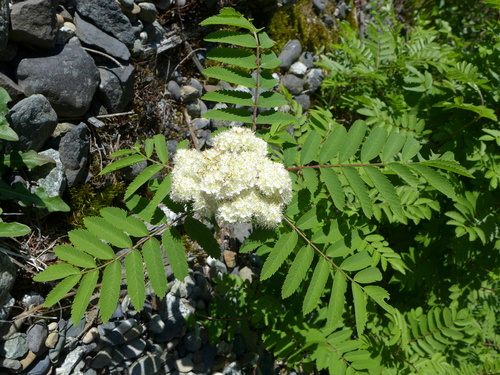
Greene's mountain ash
Sorbus scopulina
A spectacular mountain shrub known for its vibrant red berry clusters and brilliant autumn foliage, Greene's mountain ash is a cornerstone of North American high-country wildlife gardens.
Quick Identification
Size
Height: 1–4 metres (3–13 feet); Spread: 2–3 metres (6–10 feet)
Colors
Glossy dark green leaves, clusters of small white flowers, and bright orange-red to scarlet berries
Key Features
- Pinnately compound leaves with 9–13 leaflets
- Dense, flat-topped clusters of white flowers
- Glossy, bright red-orange berries that persist into winter
- Finely serrated leaflet margins and pointed tips
When You’ll See Them
Geographic range
Where Does the Greene's mountain ash Live?
Greene's mountain ash is a true westerner, native to the rugged landscapes of North America. Its range extends from the southern reaches of Alaska and across the Yukon and British Columbia, stretching southward through the Rocky Mountains and the Cascades. It is commonly found in high-elevation pockets of Washington, Oregon, and Idaho, reaching as far south as the mountains of New Mexico and Arizona, where it seeks out the cooler moisture of canyon walls.
Basemap © OpenStreetMap contributors
Behavior
Greene's mountain ash is a hardy, deciduous shrub that plays a vital role in montane and subalpine ecosystems. Unlike its taller relatives that grow as single-trunked trees, this species usually takes a multi-stemmed, shrubby form, creating dense thickets that provide excellent cover for small mammals and nesting sites for birds. It is a slow-growing but resilient plant, often found colonizing rocky slopes and forest edges where other plants struggle.
During the spring and summer, the plant focuses on energy production and flowering, attracting a wide variety of pollinators with its pungent-smelling white blooms. As autumn approaches, the foliage turns a brilliant yellow or reddish-orange, and the berries ripen into heavy, drooping clusters. These berries are a critical high-energy food source for wildlife preparing for winter or migration, and the plant often retains its fruit well into the snowy months, serving as an emergency pantry for resident species.
EverydayEarth exclusive
Camera Tips
To capture the best action on your Greene's mountain ash, mount your camera at a height of 3 to 4 feet, angled slightly downward toward a cluster of ripening berries. This level is ideal for catching both the intricate details of the plant's foliage and the visiting songbirds, such as Cedar Waxwings or Pine Grosbeaks, that frequent the shrub for its fruit. If you are targeting larger visitors like Black Bears or Mule Deer, ensure the camera is secured to a sturdy nearby post or tree, as they may nudge the shrub while browsing.
During the late summer and fall, set your camera to a higher motion sensitivity. The bright red berries are a magnet for wildlife, and you'll want to capture the quick movements of birds darting in and out of the branches. Because the leaves are quite glossy, avoid pointing the camera directly East or West to prevent sun flare during the golden hours of sunrise and sunset. A North-facing orientation typically provides the most consistent, even lighting for identifying the species visiting the shrub.
Consider using a 'Time Lapse' setting during the transition from late August to October. This allows you to document the fascinating color change of the berries from a dull green to a brilliant, waxy scarlet. For backyard setups, placing the camera near the base of the shrub can also capture ground-dwelling foragers like squirrels or chipmunks that scavenge fallen fruit. If your camera supports it, a 3-shot burst mode is excellent for catching the exact moment a bird plucks a berry from the branch.
Similar Species
Species that look similar or are commonly confused with Greene's mountain ash.
Sitka Mountain Ash
Sitka has rounded leaflet tips and brownish hairs on its winter buds, whereas Greene's has pointed leaflets and white-hairy or smooth buds.
American Mountain Ash
This species is found in Eastern North America and grows into a much larger tree, while Greene's is a Western shrub species.
Red Baneberry
While both have red berries, Baneberry is a small herb with vastly different, non-pinnate leaves and is highly poisonous.
Frequently Asked Questions
Record Greene's mountain ash at your habitat
Connect a camera to start building your own species record — AI identifies every visitor automatically.