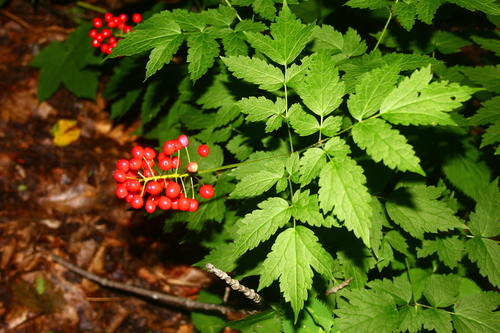
red baneberry
Actaea rubra
A striking but toxic beauty of the North American understory, Red Baneberry dazzles with glossy crimson fruit and delicate lacy foliage. It is a quintessential indicator of a healthy, mature woodland ecosystem.
Quick Identification
Size
Stands 1.5 to 3 feet (45–90 cm) tall with a spread of 1 to 2 feet (30–60 cm).
Colors
Glossy bright red berries (occasionally white); creamy white flowers; deep green serrated foliage.
Key Features
- Clusters of glossy red berries on thin, delicate stalks
- Large, deeply lobed and sharply toothed leaflets
- Dense terminal clusters of small white flowers in spring
- Stems are smooth and often reddish-tinged at the base
When You’ll See Them
Geographic range
Where Does the red baneberry Live?
Red baneberry is native to the vast temperate and boreal regions of North America. It is found throughout nearly all of Canada, from the Atlantic coast to the Pacific, and extends deep into the United States, spanning from the Northeast through the Great Lakes and across the mountainous West to California. It is particularly abundant in the damp, cool understories of northern hardwood forests and high-elevation mountain slopes.
Basemap © OpenStreetMap contributors
Behavior
Despite its toxicity, the plant plays a crucial role in woodland ecosystems. It doesn't spread aggressively, instead growing in stable, solitary clumps. Its flowers lack nectar but produce abundant pollen, attracting small bees and syrphid flies that facilitate pollination as they forage.
EverydayEarth exclusive
Camera Tips
To capture the life cycle of Red Baneberry, place your camera on a low-profile tripod or stake about 12-18 inches from the ground. Angle the lens slightly upward to showcase the contrast between the vibrant red berries and the green foliage. Because this plant grows in shaded areas, ensure your camera's ISO settings are optimized for low-light conditions to avoid grainy images in the deep woods.
Timing is everything with this species. Set your camera to time-lapse mode during late May to catch the dramatic unfurling of the leaves and the emergence of the white flower "puffs." In late July and August, switch to motion-trigger mode or frequent intervals to catch avian visitors like thrushes or catbirds that come to feast on the berries. These birds are the primary seed dispersers and provide excellent "wildlife-in-action" shots.
Since baneberry is stationary, use it as a focal point for a broader trail cam setup. It often grows near game trails or water sources in the forest. Position the camera so the plant is in the foreground (offset to the side for better composition) while monitoring for larger wildlife passing in the background. The bright red berries provide a natural "pop" of color that makes for stunning, professional-looking backyard nature photography.
Similar Species
Species that look similar or are commonly confused with red baneberry.
Frequently Asked Questions
Record red baneberry at your habitat
Connect a camera to start building your own species record — AI identifies every visitor automatically.