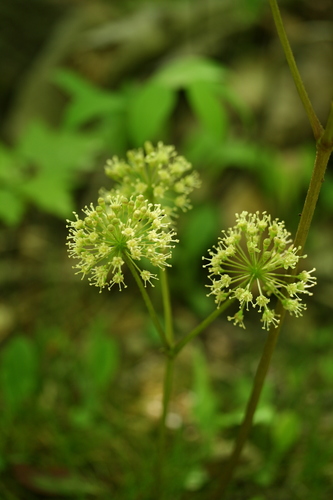
wild sarsaparilla
Aralia nudicaulis
A shadow-loving staple of the North American woods, Wild Sarsaparilla is famous for its hidden blooms and 'leaves of three.' This hardy perennial creates a lush green carpet that feeds the forest's smallest inhabitants.
Quick Identification
Size
Height of 30–60 cm (12–24 in); leaflets 5–12 cm (2–5 in) long
Colors
Bright green leaves (turning bronze or yellow in fall), greenish-white flowers, and dark purple to black berries
Key Features
- Single leaf stalk dividing into three distinct branches
- Flower stalk is shorter than leaf stalk and grows separately
- Globular clusters of tiny greenish-white flowers
- Compound leaves with 3-5 serrated leaflets per branch
When You’ll See Them
Geographic range
Where Does the wild sarsaparilla Live?
Wild Sarsaparilla is a classic inhabitant of the North American woodland, claiming a massive territory across the northern United States and nearly all of Canada. It is found from the rugged coasts of Newfoundland west to British Columbia, dipping south through the Great Lakes region and following the Appalachian Mountains all the way to Georgia. This plant is a staple of the boreal and temperate deciduous forests, thriving in the dappled light of mature tree stands.
Basemap © OpenStreetMap contributors
Behavior
Wild Sarsaparilla is a resilient perennial known for its unique 'umbrella' architecture. In early spring, it sends up a single, long-stalked leaf that branches into three sections, creating a canopy that shades the forest floor. Interestingly, the flowering stem is entirely separate and shorter than the leaf stalk, often making the blossoms difficult to spot unless you peer beneath the foliage. This structural strategy may protect the delicate flowers from heavy rain or grazing animals.
The plant spreads primarily through an extensive network of underground rhizomes, allowing it to form large, genetically identical colonies over many years. While it remains stationary, it is highly reactive to the seasons, blooming rapidly in late spring to capitalize on the sunlight before the forest canopy fully closes. In late summer, its berries provide a critical high-energy food source for woodland creatures preparing for migration or winter dormancy.
EverydayEarth exclusive
Camera Tips
To successfully document Wild Sarsaparilla with a trail camera, you must think like a botanist rather than a hunter. Since plants do not trigger standard PIR motion sensors, you must use a 'Time-Lapse' mode. Set your camera to take a photo every 2 to 4 hours starting in early May. This will allow you to create a stunning visual record of the leaf 'unfurling' and the hidden flower stalk emerging from the forest floor.
Placement is critical because the flowers and berries are often tucked away under the leaf canopy. Mount your camera on a small stake or 'ground pod' just 10 to 15 inches above the ground, angled slightly upward. This 'worm's-eye view' is the only way to capture the distinct separate flowering stem that distinguishes this species from its look-alikes. Ensure you clear away any tall blades of grass directly in front of the lens to prevent blurry foreground obstructions.
Mid-to-late summer is the best time to switch your camera back to 'Motion Trigger' or 'Hybrid' mode. Once the berries turn dark purple, the plant becomes a high-traffic zone for wildlife. Target the berry clusters specifically; this is an excellent way to capture high-quality footage of ground-foraging birds like Thrushes and Sparrows, as well as small mammals like Chipmunks and Red Squirrels. Use a high-resolution setting (4K if available) to capture the fine details of the serrated leaf margins and the glossy texture of the fruit.
Similar Species
Species that look similar or are commonly confused with wild sarsaparilla.
Frequently Asked Questions
Record wild sarsaparilla at your habitat
Connect a camera to start building your own species record — AI identifies every visitor automatically.