American ginseng
Panax quinquefolius
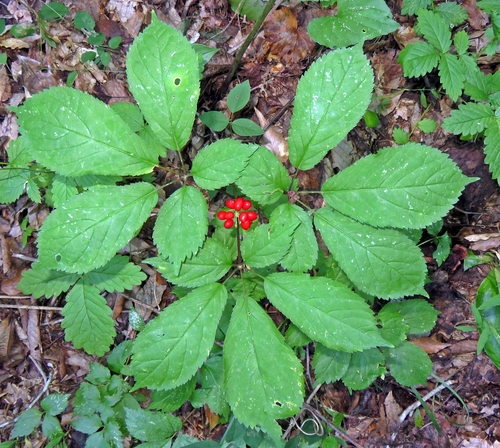
The ghost of the Eastern forest, American ginseng is a legendary perennial prized for its slow-growing roots and distinctive five-leaflet display. To find it is to discover a pocket of truly ancient, undisturbed North American woodland.
Quick Identification
Size
6–18 inches (15–45 cm) in height; leaflets 2–5 inches (5–13 cm) long
Colors
Deep forest-green foliage, yellowish-green flower umbels, and vibrant crimson-red berries in late summer
Key Features
- Palmate compound leaves typically with 5 serrated leaflets
- Clusters of bright red berries at the center of leaf whorls
- Grows in 'prongs' or leaf groups that increase with age
- Distinctive fleshy, anthropomorphic taproot
When You’ll See Them
Geographic range
Where Does the American ginseng Live?
American ginseng is native to the temperate deciduous forests of eastern North America. Its primary range extends from southern Quebec and Ontario in Canada, sweeping down through the Appalachian Mountains and into the Ozark Plateau of the United States. While its heartland lies in states like Kentucky, West Virginia, and North Carolina, it has also been successfully introduced to specialized cultivation sites in China since the mid-1970s.
Basemap © OpenStreetMap contributors
Behavior
American ginseng is a long-lived, shade-loving perennial that exhibits a slow and deliberate lifecycle. Unlike many forest plants that spread rapidly, ginseng grows incrementally, often taking three to five years just to reach reproductive maturity. It emerges from the leaf litter in early spring, unfurling its distinctive 'prongs' (compound leaves). Its growth rate is heavily dictated by the quality of the forest canopy and soil nutrients, specifically requiring high calcium levels to thrive.
The plant remains dormant throughout the winter, surviving as a dormant bud on a rhizome underground. Because it is highly sought after for its medicinal properties, it has a complex relationship with humans, ranging from careful cultivation to illegal poaching. In the wild, it acts as a sentinel of a healthy, undisturbed deciduous ecosystem, often growing near 'companion plants' like Goldenseal and Maidenhair fern.
EverydayEarth exclusive
Camera Tips
Capturing American ginseng on a backyard or trail camera requires a focus on 'Time-Lapse' mode rather than motion triggering. Since plants don't move fast enough to trigger traditional PIR sensors, set your AI camera to take a photo once or twice a day at noon when the light is most consistent. This allows you to create a stunning visual record of the plant's emergence, the unfurling of its prongs, and the transition of its berries from green to bright red.
Position your camera on a small tripod or mount it low on a nearby tree trunk, roughly 12-18 inches off the ground. Angle the lens slightly downward to capture the 'whorl' of the leaves from above, which is the most reliable way to identify the plant's age (counting the prongs). Ensure you clear away any tall blades of grass or stray twigs directly in front of the lens to prevent blurry foregrounds, but do not disturb the forest canopy above, as ginseng requires that deep shade to survive.
If you are using the camera for conservation or to protect a wild patch, place it in a discreet, 'candid' position to monitor for herbivores like white-tailed deer, which frequently graze on the foliage. During the late summer (August and September), the bright red berries provide a high-contrast focal point that makes for excellent photography. High-resolution settings are a must to capture the fine serrations on the leaf edges and the texture of the central flower stalk.
Similar Species
Species that look similar or are commonly confused with American ginseng.
Virginia Creeper
A climbing vine with five leaflets that lacks the central berry stalk and fleshy taproot of ginseng.
Wild Sarsaparilla
The flower/berry stalk grows on a separate stem from the leaves, whereas ginseng's berries emerge from the center of the leaf whorl.
Dwarf Ginseng
Much smaller in size, reaching only 3-8 inches, and features rounder, more globose flower clusters.
Frequently Asked Questions
Record American ginseng at your habitat
Connect a camera to start building your own species record — AI identifies every visitor automatically.