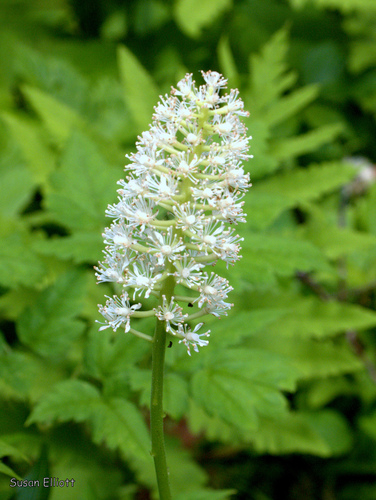
white baneberry
Actaea pachypoda
Known for its eerie berries that resemble miniature porcelain eyeballs, the white baneberry is a striking and mysterious inhabitant of the North American forest floor.
Quick Identification
Size
Height of 45–75 cm (18–30 in) with a spread of 30–60 cm (12–24 in)
Colors
White berries with a single black dot; vibrant magenta-red stalks; deep green foliage
Key Features
- Clusters of white berries with a distinct black 'pupil' mark
- Thickened, fleshy red stalks (pedicels) supporting the fruit
- Deeply lobed, sharply toothed compound leaves
- Small, fuzzy white flower clusters in spring
When You’ll See Them
Geographic range
Where Does the white baneberry Live?
White baneberry is native to the temperate regions of North America. It is most commonly found throughout the Eastern United States and Eastern Canada, stretching from New Brunswick and Quebec down to Georgia and as far west as Minnesota and Missouri. It thrives primarily in the Appalachian highlands and the Great Lakes basin, where the soil is rich and the forest canopy provides consistent shade.
Basemap © OpenStreetMap contributors
Behavior
White baneberry is a long-lived herbaceous perennial that spends its life on the forest floor. It emerges in early spring with lush, fern-like foliage, followed by a brief but beautiful flowering period. As a slow-growing species, it focuses its energy on developing its highly distinctive fruit over the summer months. Unlike many other woodland plants that disappear after spring, the white baneberry remains a focal point of the understory well into autumn.
The plant is famously toxic—every part contains cardiogenic toxins, though the berries are the most concentrated. This chemical defense protects the plant from being grazed by deer or rabbits. Interestingly, despite its toxicity to mammals, the plant relies on certain bird species to eat the berries and disperse the seeds. In a backyard setting, it acts as a permanent resident that requires very little maintenance once established in the right conditions.
EverydayEarth exclusive
Camera Tips
To capture the stunning detail of white baneberry on a trail camera, placement is everything. Since the plant is low-growing, mount your camera on a short stake or ground-level 'tortoise' mount, roughly 12 inches off the ground. Position the lens about 2 to 3 feet away from the berry clusters. Using a camera with a macro lens or a close-focusing distance is ideal, as the 'doll's eyes' effect is best seen in high-detail close-ups where the black stigma (the 'pupil') is sharp.
Lighting is your biggest challenge in the deep shade where this plant thrives. Avoid using a standard white LED flash at night, as it will likely overexpose the bright white berries, turning them into featureless white blobs. Instead, rely on natural light during the 'golden hours' of early morning or late afternoon. If your camera has adjustable exposure settings, dial the exposure down slightly (-0.5 or -1.0) to preserve the delicate textures of the waxy white fruit against the dark green leaves.
While the plant doesn't move, it makes an excellent 'stage' for capturing woodland visitors. Set your camera to a high-trigger sensitivity to catch the birds, such as ruffed grouse or thrushes, that occasionally visit to feed on the berries. Because the berries are persistent, you can set up a time-lapse over several weeks in late summer to watch them transition from small green nubs to the iconic white porcelain-like spheres on their striking red stalks.
Similar Species
Species that look similar or are commonly confused with white baneberry.
Frequently Asked Questions
Record white baneberry at your habitat
Connect a camera to start building your own species record — AI identifies every visitor automatically.