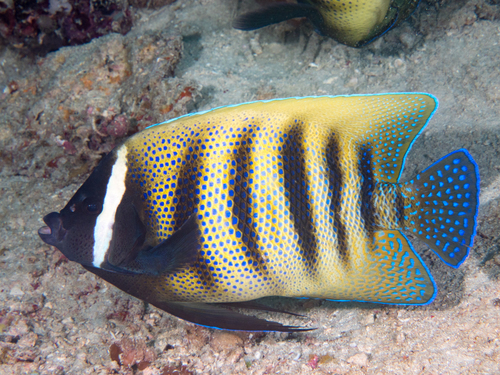
Sixband Angelfish
Pomacanthus sexstriatus
A shy giant of the Indo-Pacific reefs, the Sixband Angelfish is a master of camouflage and grace. With its striking blue-spotted fins and bold vertical bars, it is one of the most sought-after sightings for underwater explorers.
Quick Identification
Size
Grows up to 46 cm (18 inches) in length; typically weighs between 0.8 and 1.5 kg (1.8-3.3 lbs).
Colors
Creamy yellow to tan body with six prominent vertical black bands; neon blue spots on scales and fins; dark head with a white vertical stripe.
Key Features
- Six distinct vertical black bars on the body
- Brilliant blue speckles on the fins and tail
- White vertical bar located just behind the eye
- Prominent blue-tipped spine on the lower operculum (gill cover)
When You’ll See Them
Geographic range
Where Does the Sixband Angelfish Live?
The Sixband Angelfish is a quintessential inhabitant of the sprawling Indo-Pacific marine province, thriving in tropical waters. Its native range extends from the Ryukyu Islands of Japan down through the Philippines and Indonesia to the northern coasts of Australia and the Solomon Islands. In these warm currents, they are core residents of both pristine coral reefs and more silty coastal lagoons, often seen patrolling territory in the Great Barrier Reef.
Basemap © OpenStreetMap contributors
Behavior
The Sixband Angelfish is a remarkably shy and wary species compared to its bolder relatives. While they are often seen in pairs, suggesting a monogamous social structure, they are quick to retreat into the safety of reef crevices or caves when they sense a disturbance. Unlike some reef fish that ignore divers or cameras, this species maintains a respectful distance, making it a rewarding challenge for wildlife observers.
These fish are highly territorial and spend much of their day patrolling a specific area of the reef. They are known for their peculiar ability to produce a loud 'thumping' or grunting sound when they feel threatened or during territorial disputes. This sound is produced by vibrating their swim bladder, a behavior often caught on underwater microphones before the fish is even visible on screen.
EverydayEarth exclusive
Camera Tips
Capturing the Sixband Angelfish on an underwater camera requires a blend of patience and strategic placement. Because these fish are naturally skittish, avoid mounting your camera in open water. Instead, position the lens near 'cleaning stations' or at the mouth of large crevices where they often seek shelter. Aiming the camera slightly upward from a lower reef shelf can help capture their impressive silhouette against the sunlit surface water.
Since they are most active during the middle of the day, lighting is your biggest ally and enemy. In depths greater than 5 meters, red light is filtered out by the water, making the fish look dull and greenish. Use a camera with a red filter or provide external underwater video lights with a high CRI (Color Rendering Index) to bring out the brilliant neon blue spots and the subtle tan hues of their body. If using motion-triggering AI, ensure the sensitivity is high, as they often dart quickly across the frame.
To attract them closer to a stationary backyard reef camera, you don't necessarily need bait; instead, look for areas with high sponge density. They are creatures of habit and will follow a similar patrol path every day. If you notice a Sixband Angelfish on your feed, it is likely to return to that exact spot at the same time tomorrow. Set your frame to include a mix of foreground reef structure and open water to catch both their foraging and patrolling behaviors.
Similar Species
Species that look similar or are commonly confused with Sixband Angelfish.
Frequently Asked Questions
Record Sixband Angelfish at your habitat
Connect a camera to start building your own species record — AI identifies every visitor automatically.