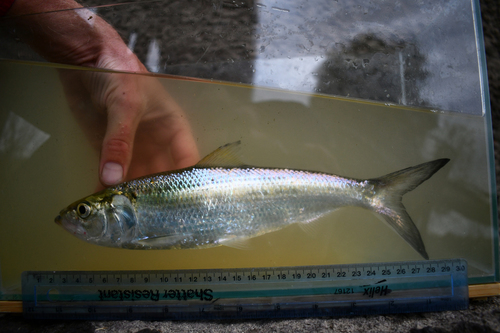
Skipjack Shad
Alosa chrysochloris
Meet the 'Tennessee Tarpon,' an acrobatic powerhouse of the river. Known for leaping through the air and its brilliant silvery sheen, the Skipjack Shad is a favorite for those who love high-energy river wildlife.
Quick Identification
Size
Typically 12–16 inches (30–40 cm) long, reaching up to 21 inches (53 cm). Weight usually ranges from 1–3.5 lbs (0.45–1.6 kg).
Colors
Brilliant silvery sides with an iridescent gold or purple sheen; the back is typically a dark blue-green or olive color. Fins are generally clear to dusky.
Key Features
- Large, protruding lower jaw that extends past the upper jaw
- Deeply forked tail fin
- Slender, streamlined silvery body
- Rows of specialized scales called 'scutes' along the belly creating a serrated edge
- Large, black eyes with adipose eyelids
When You’ll See Them
Behavior
The Skipjack Shad is a high-energy, migratory fish known for its incredible speed and acrobatic displays. Its common name comes from its habit of 'skipping' across the water's surface while chasing schools of prey or attempting to evade predators. These fish are highly social and are almost always found in large schools, particularly in areas with fast-moving currents below dams or at the confluence of rivers.
Because they are highly migratory, their behavior is dictated by the seasons. In the early spring, they move upstream in massive numbers to spawn. While they are not typically a primary food fish for humans due to their bony structure and oily flesh, they are legendary among anglers as 'Tennessee Tarpons' because of their fierce fight and frequent jumping when hooked. They are also a critical species for the ecosystem, serving as a primary host for the larvae of several endangered freshwater mussel species.
EverydayEarth exclusive
Camera Tips
Capturing the Skipjack Shad on camera requires a specialized approach since they are almost exclusively found in moving water. If you live near a river or have a dock, the best setup is a submerged action camera or a specialized underwater 'fishing' camera. Mount your camera to a dock piling or a weighted tripod placed in shallow, rocky areas where the current is broken by eddies. The interface between fast and slow water is where these predators wait to ambush prey, making it the ideal spot for a strike-zone shot.
To attract Skipjack to your camera's field of view, try using a 'chum' approach with small bits of crushed shiny foil or small silver spoons suspended in the current. Their predatory instinct is triggered by flashes of silver, which they mistake for minnows. If you are using a camera with motion detection, set the sensitivity to high, as these fish move exceptionally fast. High frame rate settings (60fps or higher) are essential to catch their lightning-quick strikes and prevents the 'silver blur' effect caused by their reflective scales.
Timing is everything for the Skipjack. During the spring spawning run, focus your efforts on the 'tailwaters' below dams or around bridge pilings. During the day, the best light for underwater photography is between 10 AM and 2 PM when the sun is directly overhead, penetrating the water column. However, if you are looking for their famous jumping behavior, set up a shore-based trail camera at a low angle (about 1-2 feet above the water line) pointing toward the surface during dawn or dusk, which is when they are most active at the surface chasing insects.
Similar Species
Species that look similar or are commonly confused with Skipjack Shad.
Frequently Asked Questions
Record Skipjack Shad at your habitat
Connect a camera to start building your own species record — AI identifies every visitor automatically.