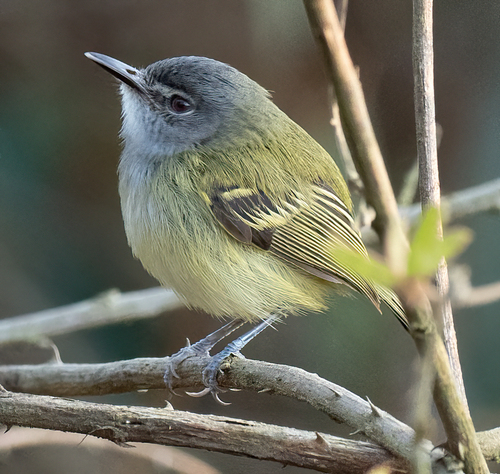
Slate-headed Tody-Flycatcher
Poecilotriccus sylvia
A tiny, energetic master of the undergrowth, the Slate-headed Tody-Flycatcher is a hidden gem of the tropical garden. With its sophisticated grey cap and rhythmic clicking call, it brings a sense of lively mystery to any backyard thicket.
Quick Identification
Size
Length: 9–10 cm (3.5–4 in); Weight: 6–8 g (0.2–0.3 oz)
Colors
Slate-grey crown and face, olive-green back, white throat, and pale yellow underparts. Dark wings feature two yellowish wing bars.
Key Features
- Distinctive slate-grey head and face
- Pale yellowish-white iris
- Short, broad, flat bill
- Olive-green upperparts with yellow-washed belly
When You’ll See Them
Behavior
The Slate-headed Tody-Flycatcher is a high-energy insectivore that spends much of its time skulking in dense thickets and vine tangles. Unlike the more conspicuous Common Tody-Flycatcher, this species prefers the shadows of forest edges and overgrown gardens. They are known for their 'sally-glean' foraging technique, where they make sudden, short hops to snatch insects from the underside of leaves with an audible snap of the bill.
These birds are highly territorial and are often first detected by their voice—a series of sharp, rhythmic 'ticking' or clicking notes that sound almost mechanical. While they aren't social with other bird species, they are frequently seen in pairs, moving quickly through the mid-story of the canopy or the dense shrub layer. They generally ignore human presence as long as they have a thicket to retreat into.
EverydayEarth exclusive
Camera Tips
To capture the Slate-headed Tody-Flycatcher, you must rethink traditional bird photography. These birds rarely visit elevated feeders or open perches. Instead, position your AI-powered camera at chest height (about 3 to 5 feet off the ground) pointed toward the interior of a dense native shrub or a 'messy' corner of your garden where vines and bushes overlap. This is their preferred hunting ground.
Because they are tiny and move with rapid, jerky motions, set your camera to its highest sensitivity or use a 'burst' photo mode if available. If your camera supports video, 60fps is ideal to catch the moment they strike an insect. Lighting can be a challenge in their shady habitats, so try to angle the camera to catch the morning sun filtering through the leaves, which will highlight the contrast between their slate-grey head and yellow belly.
A shallow, dripping water feature is one of the few things that will lure them into the open. Unlike many birds that prefer large baths, these flycatchers appreciate a very fine mist or a slow-dripping leaf. Place your camera 2-3 feet away from a 'dripper' setup for the best chance of a clear, centered shot. Avoid using loud mechanical triggers, as their sharp hearing makes them wary of sudden noises near their nesting sites.
Similar Species
Species that look similar or are commonly confused with Slate-headed Tody-Flycatcher.
Frequently Asked Questions
Record Slate-headed Tody-Flycatcher at your habitat
Connect a camera to start building your own species record — AI identifies every visitor automatically.