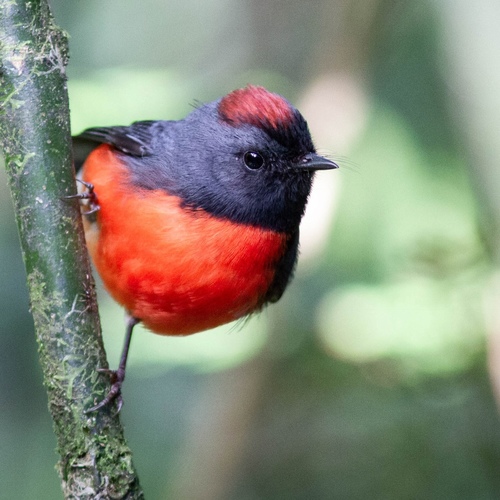
Slate-throated Redstart
Myioborus miniatus
With its charcoal-dark back and a breast like a glowing ember, the Slate-throated Redstart is a master of the 'flush-and-flash' hunt. Watch for its signature white-tipped tail as it dances through the montane shadows of your garden.
Quick Identification
Size
Length: 12-13.5 cm (4.7-5.3 in); Wingspan: 18-20 cm (7-8 in); Weight: 8.5-11 g (0.3-0.4 oz)
Colors
Slate-gray to blackish upperparts, vibrant red to orange-yellow belly (varies by region), white outer tail feathers, and a dark chestnut crown patch.
Key Features
- Dark slate-gray upperparts
- Bright red or yellow breast and belly
- White outer tail feathers frequently fanned
- Small chestnut-colored patch on the crown
- Highly active, 'fidgety' movement
When You’ll See Them
Behavior
The Slate-throated Redstart is a bundle of kinetic energy, almost never staying still for more than a second. They are famous for their 'flush-chase' foraging technique: they fan their broad tails to show off white outer feathers, which startles insects into flight, allowing the bird to snatch them out of the air. This constant movement makes them a joy to watch but a challenge to photograph without the right equipment.
While they are territorial during the breeding season, they often join mixed-species foraging flocks during the rest of the year, moving alongside tanagers and other warblers. They aren't particularly shy around humans and can be quite curious, often flitting through the mid-story and undergrowth of garden edges or forest borders in montane regions. You will often hear their sharp 'chip' call before you see their bright belly.
EverydayEarth exclusive
Camera Tips
To capture the Slate-throated Redstart on camera, focus on 'perch-and-pounce' zones. Look for horizontal branches, railings, or low-hanging vines near dense vegetation where they wait for insects. Because they are small and move with sudden, jerky motions, set your AI-powered camera to its highest trigger speed and use a 'burst' or 'multi-shot' mode. Aim the camera at eye level—approximately 4 to 6 feet high—to catch them as they patrol the understory.
Lighting is the biggest challenge when filming this species. Their slate-gray backs can easily disappear into the deep shadows of a forest canopy, while their bright red or yellow bellies can become 'blown out' (overexposed) in direct sunlight. Position your camera to face north or south to avoid harsh backlighting. Soft, dappled light under a garden trellis or a leafy tree provides the best environment to capture the rich contrast between their dark upperparts and fiery underparts.
While you cannot lure these warblers with traditional birdseed, you can attract them with water. A small solar-powered fountain or a 'wiggler' in a shallow birdbath is an irresistible magnet for them. Place your camera 3-5 feet from the water source. If your camera has a high-speed video mode, use it to capture their unique tail-fanning behavior in slow motion, which is one of the most charismatic sights in the backyard birding world.
During the cooler months or in higher altitudes, these birds are very active as they seek out high-protein insects. If you are using a trail camera, look for 'edges'—places where a lawn meets thick brush or where a stream cuts through the woods. These are the Redstart's preferred highways. Ensure your camera's PIR (motion) sensor sensitivity is set to 'High' to detect such a lightweight, fast-moving subject.
Similar Species
Species that look similar or are commonly confused with Slate-throated Redstart.
Frequently Asked Questions
Record Slate-throated Redstart at your habitat
Connect a camera to start building your own species record — AI identifies every visitor automatically.