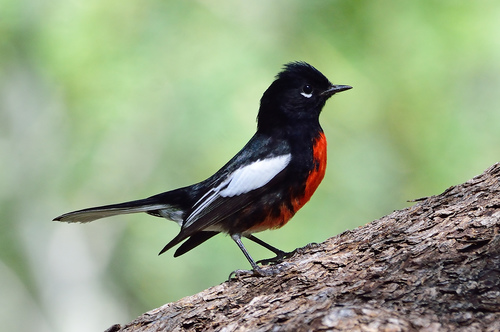
Painted Redstart
Myioborus pictus
With its bold crimson belly and rhythmic 'wing-flashing' dance, the Painted Redstart is the showstopper of the Southwest's mountain canyons. This energetic warbler brings a splash of tropical color to backyard water features and oak groves.
Quick Identification
Size
Length: 5.1–5.9 in (13–15 cm); Wingspan: approx 8.3 in (21 cm); Weight: 0.3–0.4 oz (8–12 g)
Colors
Glossy jet-black body with a brilliant scarlet-red belly; bold white patches on the wings and outer tail feathers; distinctive white crescent under each eye.
Key Features
- Large bright red patch on the lower breast and belly
- Broad white wing bars visible even when perched
- Frequent fanning of the tail to show white outer feathers
- High-contrast black plumage with white 'half-moon' eye crescents
When You’ll See Them
Behavior
The Painted Redstart is a high-energy acrobat of the mountain canyons. Unlike many warblers that skulk in dense foliage, this species is bold and constantly on the move, often seen 'dancing' along branches. They have a unique foraging habit of pivoting their bodies and fanning their tails to flash their white outer feathers, a tactic used to startle insects into flight so they can be snatched mid-air.
Socially, they are fascinating because both sexes are accomplished singers, which is a rarity among North American warblers. While they are territorial during the breeding season, they are generally curious and may approach backyard environments that offer water or dense native oaks. They are most active in the mid-canopy but will frequently descend to ground level to drink or bathe in shallow pools.
EverydayEarth exclusive
Camera Tips
To capture the Painted Redstart on your backyard camera, focus entirely on water. Because these birds are insectivores and rarely visit seed feeders, a birdbath with a 'wiggler' or a small recirculating fountain is your best bet. Position your camera about 3 to 5 feet away from the water source, ideally at bird-eye level (about 3-4 feet off the ground), looking slightly down into the basin. They are known for their frantic bathing style, so use a high frame rate or 'burst mode' to avoid blurry shots of their rapidly fanning wings.
Placement is crucial: look for shaded areas near oak or pine trees. If you are using a trail camera in a more natural setting, mount it 4 to 6 feet high on a tree trunk overlooking a rocky stream or a moist canyon floor. These birds spend a lot of time 'hitching' along tree trunks and large horizontal limbs like a nuthatch, so angling your camera to cover the interface between a trunk and a large branch can yield spectacular profile shots. Ensure your camera has a fast trigger speed (0.2s or less) because their movements are erratic and lightning-fast.
While seeds won't work, you can sometimes lure them with live mealworms in a shallow dish placed near a water feature, especially during the spring migration. In terms of lighting, avoid direct midday sun which can 'blow out' the white wing patches against the dark black body. Soft, diffused morning light will highlight the glossy sheen of their black feathers and the depth of the red on their belly perfectly. If your camera supports it, set the exposure compensation slightly lower (-0.5 or -1.0) to preserve the detail in those bright white wing bars.
Similar Species
Species that look similar or are commonly confused with Painted Redstart.
Frequently Asked Questions
Record Painted Redstart at your habitat
Connect a camera to start building your own species record — AI identifies every visitor automatically.