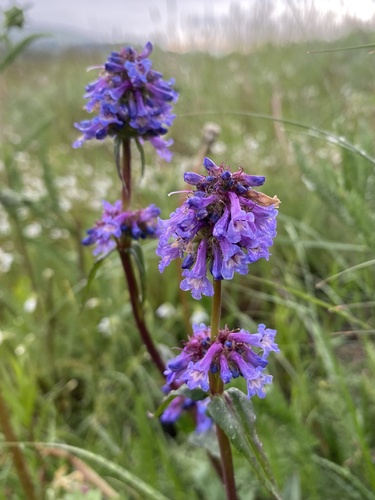
Small-flower Beardtongue
Penstemon procerus
A pint-sized powerhouse of the high country, the Small-flower Beardtongue blankets meadows in stunning shades of indigo and violet. This hardy perennial is a magnet for native bees and a must-see for mountain hikers.
Quick Identification
Size
Height ranges from 2 to 16 inches (5-40 cm); mat-forming foliage spreads 6 to 12 inches (15-30 cm) wide.
Colors
Clusters of vibrant deep blue to purple tubular flowers, often featuring a white or pale throat; leaves are a rich, medium-to-dark green.
Key Features
- Tight, ball-like clusters (whorls) of tiny flowers along the upper stem
- Mat-forming, evergreen basal leaves that hug the ground
- Tubular flowers under 1 centimeter in length
- Smooth, hairless outer flower surfaces with potential yellow hairs inside
When You’ll See Them
Behavior
Small-flower Beardtongue is a resilient herbaceous perennial that acts as a primary groundcover in alpine and subalpine environments. It exhibits a unique growth habit where it spends most of the year as a dense, low-growing mat of foliage, which helps it survive harsh winter winds and heavy snowpack. During the late spring and summer, it sends up erect, unbranched stems to display its distinctive tiered clusters of blooms.
While the plant itself is stationary, it is a hub of biological activity. The species is highly social in an ecological sense, often growing in large colonies that create a 'purple carpet' effect across mountain meadows. It has a symbiotic relationship with native bees, particularly mason bees and leafcutter bees, whose small size is perfectly suited for the tiny floral tubes. Unlike some more aggressive garden plants, the Small-flower Beardtongue is a slow-growing, well-behaved resident of both wild landscapes and native rock gardens.
EverydayEarth exclusive
Camera Tips
Capturing the Small-flower Beardtongue effectively requires a focus on macro photography and time-lapse settings. Because the individual flowers are remarkably small (often less than 1cm), your camera should be positioned as close as the minimum focal distance allows—usually between 1.5 to 3 feet depending on your lens. Use a ground-level tripod or a stake mount to stabilize the camera, as even a slight breeze can cause the thin stems to sway, resulting in motion blur in your shots.
To capture the 'wildlife' aspect of this wildflower, set your AI camera to trigger on small movements. This will allow you to document the various native bees and butterflies that visit the nectar-rich tubes. Since these pollinators are fast, a high shutter speed or a 'burst mode' is essential. If your camera setup allows for external lighting, a small fill-flash or a reflector can help illuminate the white hairs inside the dark purple throats of the flowers, which is a key identification feature for this species.
For those interested in the plant's development, time-lapse is the way to go. Set your camera to take one photo every 2-4 hours starting in late May. This will capture the dramatic 'telescoping' effect as the flowering stems rise from the flat basal mat and the tight green buds begin to show their purple hues. Ensure the camera is angled slightly upward to catch the blue of the sky behind the purple blooms, which provides a stunning natural contrast.
Finally, consider the lighting conditions of your backyard or trail location. The deep blues and purples of the Small-flower Beardtongue are most vibrant during the 'blue hour' just after sunrise or during overcast days. Harsh midday sun can wash out the delicate colors and create deep shadows in the whorled clusters, so try to time your best captures for the softer light of early morning.
Similar Species
Species that look similar or are commonly confused with Small-flower Beardtongue.
Frequently Asked Questions
Record Small-flower Beardtongue at your habitat
Connect a camera to start building your own species record — AI identifies every visitor automatically.