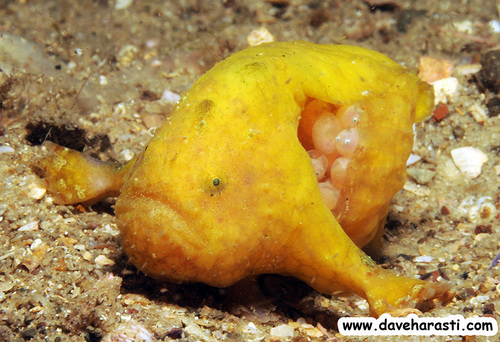
Smooth Anglerfish
Histiophryne bougainvilli
The Smooth Anglerfish is a cryptic wonder of the Australian coast, 'walking' across the seafloor with hand-like fins and vanishing into its surroundings with near-perfect camouflage.
Quick Identification
Size
A small, stocky fish reaching 7-10 cm (2.7-4 inches) in length.
Colors
Highly variable to match surroundings; typically cream, pink, orange, or mottled green with dark blotches that mimic sponges.
Key Features
- Completely smooth skin lacking dermal spinules
- Modified pectoral fins that look and function like hands
- Short, thin illicium (fishing rod) usually hidden from view
- Heavy-set, globose body shape
When You’ll See Them
Geographic range
Where Does the Smooth Anglerfish Live?
The Smooth Anglerfish is a native resident of the temperate and subtropical coastal waters surrounding Australia. Its core range is concentrated along the rocky reefs and sheltered bays of New South Wales, Queensland, and Western Australia. While sightings are rare due to its elusive nature, it is a quintessential specialist of the Australian continental shelf, particularly in areas rich with sponge growth and vertical structures like jetty pylons.
Basemap © OpenStreetMap contributors
Behavior
As ambush predators, their behavior is defined by extreme patience. They rely on their incredible camouflage to blend in with the colonial sponges they inhabit, often remaining in the exact same spot for days. When they do move, it is with a slow, deliberate crawl. They are generally solitary and can be quite territorial of their chosen sponge, though they are completely harmless to humans and are a prize find for patient divers and underwater observers.
EverydayEarth exclusive
Camera Tips
Capturing a Smooth Anglerfish on a submerged camera requires precision placement. These fish do not 'patrol' an area; they sit in very specific micro-habitats. Look for healthy sponge gardens or pier pylons encrusted with growth. Mount your camera in a waterproof housing as low to the seafloor as possible, using a weighted tripod to ensure stability against tidal currents. Angle the lens slightly upward if placing it at the base of a sponge, or horizontally if monitoring a flat reef patch.
Because the Smooth Anglerfish moves so infrequently, traditional motion-triggering software may fail to detect it. The most effective strategy is to use a time-lapse mode, capturing a high-resolution frame every 30 to 60 seconds. This allows you to 'scrub' through the footage later to spot the subtle changes in position or the lightning-fast strike when it consumes prey. If your camera setup allows for external lighting, use a diffused red light at night to avoid bleaching out their intricate camouflage patterns.
Check for hotspots where small shrimp or gobies congregate, as these are the primary food sources that will draw an anglerfish out of deep cover. If you are using an AI-powered system, train your detection on 'sponge-like' shapes that move slightly between frames. Be prepared to leave your camera in place for several days, as these fish are the embodiment of the 'slow life' and may only reveal their presence during specific tidal movements or light transitions.
Similar Species
Species that look similar or are commonly confused with Smooth Anglerfish.
Frequently Asked Questions
Record Smooth Anglerfish at your habitat
Connect a camera to start building your own species record — AI identifies every visitor automatically.