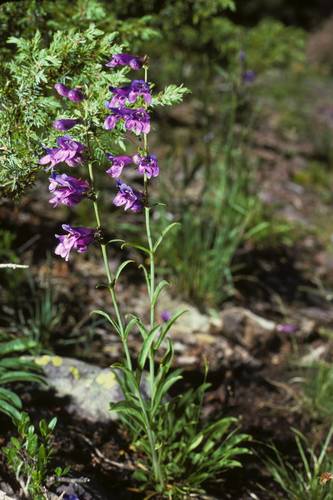
Smooth Beardtongue
Penstemon subglaber
A masterpiece of the high desert and mountain slopes, the Smooth Beardtongue dazzles with its hairless, waxy stems and vibrant violet-blue trumpets.
Quick Identification
Size
Grows to a height of 30 to 80 cm (12 to 32 inches) with a spread of approximately 15 to 30 cm (6 to 12 inches).
Colors
Brilliant shades of sky blue to deep violet-purple; foliage is a distinctive waxy, glaucous green.
Key Features
- Hairless, smooth stems and leaves (subglaber)
- Tubular, five-lobed flowers arranged in a narrow cluster
- Lance-shaped leaves that grow opposite each other
- A sterile stamen (staminode) featuring a tuft of tiny yellow hairs
When You’ll See Them
Behavior
The Smooth Beardtongue is a perennial wildflower known for its resilient nature and striking floral display. Unlike many other members of the Penstemon genus, this species is almost entirely glabrous, meaning it lacks the fine hairs typically found on the stems and leaves. It spends the early spring forming a basal rosette of leaves before sending up tall, vertical flower spikes in the heat of the summer.
As a key member of the western ecosystem, it plays a vital social role in the plant community by acting as a primary nectar source for specialized pollinators. It has a symbiotic relationship with long-tongued bees and hummingbirds, who have evolved to navigate the narrow tubular structure of its blooms. In a garden or backyard setting, it is a non-aggressive species that provides structural height and vibrant color without crowding out neighboring flora.
EverydayEarth exclusive
Camera Tips
To capture the best images of Smooth Beardtongue, treat the plant as a stage for wildlife. Set your camera on a short tripod or a ground mount, positioning the lens at the same height as the flower spikes. An upward-tilted angle (about 15-20 degrees) allows you to see inside the tubular bells of the flowers, which is essential for capturing the 'beard'—the hairy sterile stamen—and any insects crawling inside for nectar.
Because this species is a magnet for hummingbirds and clearwing moths, use a high shutter speed (at least 1/1000s) if your camera settings allow. If you are using a trail camera with a fixed focus, place it approximately 2 to 3 feet away from the main cluster of blooms. This distance is the 'sweet spot' for most backyard AI cameras to trigger on movement without the subject being a blur of purple. Early morning light (6 AM to 9 AM) provides the softest shadows and makes the waxy, green leaves pop against the blue flowers.
Time-lapse mode is particularly rewarding for this species. Set your camera to take a photo every 15 minutes during the peak blooming week in July. When played back, you can watch the individual flower buds 'unzip' and the stems lean toward the sun throughout the day. If you want to attract more animal activity to the frame, ensure the plant is well-watered; hydrated Penstemons produce significantly more nectar, making them the busiest 'refueling station' in your yard.
Similar Species
Species that look similar or are commonly confused with Smooth Beardtongue.
Frequently Asked Questions
Record Smooth Beardtongue at your habitat
Connect a camera to start building your own species record — AI identifies every visitor automatically.