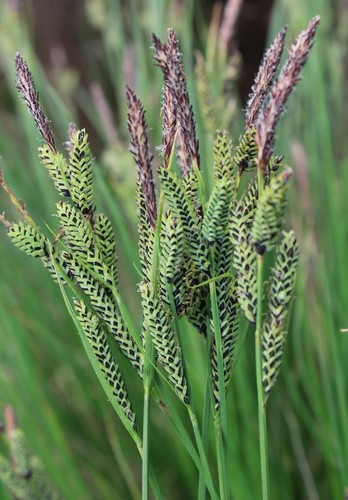
smooth black sedge
Carex nigra
A striking wetland staple known for its coal-colored spikes and hardy nature. The smooth black sedge is a cornerstone of damp meadows, providing essential habitat for a variety of backyard visitors.
Quick Identification
Size
Stands 10–70 cm (4–28 inches) tall with leaves 2–5 mm (0.08–0.2 inches) wide
Colors
Dark purplish-black to coal-black floral scales (glumes); vibrant green to olive-green seed pouches (perigynia); blue-green (glaucous) foliage
Key Features
- Distinctive soot-colored or black flower spikes
- Creeping rhizomes that form dense tufts or mats
- Blue-green, narrow leaves with slightly rough edges
- Lowest leaf-like bract is shorter than the entire flower cluster
When You’ll See Them
Geographic range
Where Does the smooth black sedge Live?
Smooth black sedge is natively widespread across the temperate and boreal regions of Europe, stretching from the British Isles and Scandinavia down to the Mediterranean and across into Western Asia and Siberia. It has also successfully colonized large portions of Eastern North America, particularly in Atlantic Canada and the Northeastern United States, where it thrives in coastal and alpine wetlands. This resilient species is even found in the damp, high-altitude meadows of Northern Africa, making it a truly cosmopolitan inhabitant of the Northern Hemisphere’s wettest landscapes.
Basemap © OpenStreetMap contributors
Behavior
Smooth black sedge is a resilient perennial that primarily spreads through an underground network of creeping rhizomes. Unlike many clump-forming sedges, this species is capable of forming expansive, carpet-like colonies in saturated environments. It is a slow-growing but persistent plant that plays a vital role in wetland succession, helping to stabilize mudflats and the banks of slow-moving streams. Its growth habit is highly adaptive; in very wet conditions, it may grow taller to keep its reproductive spikes above the water line.
While it lacks the active movement of animals, smooth black sedge exhibits a fascinating seasonal cycle that interacts heavily with local fauna. In the spring, it is one of the first plants to provide cover for emerging amphibians. By mid-summer, its dense foliage and sturdy stems serve as a critical resting site for dragonflies and damselflies. For the backyard observer, it acts as a reliable indicator of soil moisture and health, often signaling the presence of a high water table or a hidden spring.
EverydayEarth exclusive
Camera Tips
Capturing the smooth black sedge on camera requires a shift in mindset—you aren't just filming a plant, you are filming a 'stage' for wetland wildlife. To get the best results, use a ground-level spike mount to position your camera just 6 to 10 inches off the deck. Angle the lens slightly upward to capture the contrast of the dark black spikes against the sky or lighter background vegetation. This low angle is also the perfect height for catching the frogs, toads, and salamanders that frequently use the base of the sedge for cover.
Because this species grows in high-moisture areas, lens fogging can be a major issue. Use a camera housing with a rain shield or apply an anti-fog treatment to the lens cover. If your camera allows for focal adjustments, set it to a 'macro' or 'near' focus mode; the intricate texture of the black glumes and the tiny yellow stamens that emerge in late spring are stunning when viewed up close. If you are using a trigger-based camera, set the PIR sensitivity to high, as the slight movement of a dragonfly landing on a sedge blade is enough to trigger a high-quality capture.
Time-lapse mode is particularly rewarding with smooth black sedge. Set your camera to take one photo every 30 minutes during the peak growing months of May and June. When played back, you will see the remarkable speed at which the flower spikes emerge and darken. For nighttime shots, avoid using a heavy flash which can 'blow out' the green of the leaves; instead, use low-intensity infrared (No-Glow) to capture nocturnal visitors like snails or small rodents that forage among the rhizomes.
Similar Species
Species that look similar or are commonly confused with smooth black sedge.
Frequently Asked Questions
Record smooth black sedge at your habitat
Connect a camera to start building your own species record — AI identifies every visitor automatically.