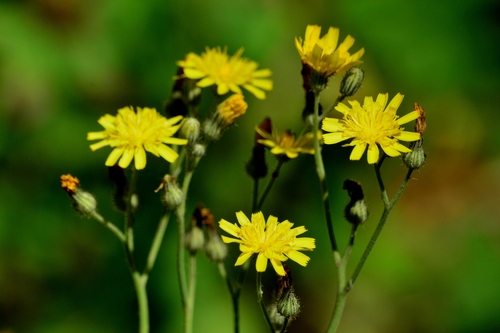
smooth hawkweed
Pilosella piloselloides
With its clusters of vibrant yellow blooms and resilient nature, smooth hawkweed is a common sight in summer meadows. Though often considered a weed, its ability to thrive in the toughest soils makes it a fascinating subject for backyard naturalists.
Quick Identification
Size
Height 30–90 cm (12–36 inches); flower heads 1.5–2 cm (0.6–0.8 inches) wide
Colors
Bright yellow flower heads; bluish-green leaves; pale green to purplish stems
Key Features
- Cluster of 5-30 small yellow flower heads at the top of a single stem
- Mostly leafless, upright stems that contain milky sap
- Basal rosette of lance-shaped leaves with long, white hairs
- Stems are notably smooth or hairless near the top compared to other hawkweeds
When You’ll See Them
Geographic range
Where Does the smooth hawkweed Live?
Native to Europe and Western Asia, smooth hawkweed has become widely naturalized across the temperate regions of North America. It is particularly common throughout the northeastern United States and southeastern Canada, where it thrives in human-altered landscapes. Because of its hardy nature, it has also established smaller populations in parts of the Pacific Northwest and various temperate zones across the globe where it was introduced via contaminated seed mixes.
Basemap © OpenStreetMap contributors
Behavior
Smooth hawkweed is a perennial herbaceous plant known for its aggressive and colonial growth habits. It primarily spreads through a combination of wind-dispersed seeds and horizontal underground rhizomes or above-ground runners called stolons. This allows a single plant to quickly establish a dense mat that can crowd out native grasses and other wildflowers, particularly in nutrient-poor soils.
One of the most fascinating aspects of its behavior is apomixis, a form of asexual reproduction where the plant produces viable seeds without the need for pollination. While it still attracts various bees and butterflies with its nectar, it does not rely on them to reproduce. In a backyard setting, it is often seen as a persistent pioneer species, being among the first to colonize bare or disturbed patches of earth.
EverydayEarth exclusive
Camera Tips
To capture high-quality images of smooth hawkweed with a backyard AI camera, focus on the plant's unique vertical structure. Place your camera on a low-profile stake or small tripod about 1.5 to 2 feet away from the central stem. Since these flowers are heliotropic—meaning they track the sun—positioning your camera to face south will ensure you capture the 'faces' of the yellow blooms during their peak midday expansion.
For the best identification results, ensure your camera is set to a high resolution to catch the fine details of the stem. The key to identifying this specific species is the lack of hairs on the upper portion of the flower stalk. If your camera has a macro mode or a close-focusing distance, use it to document the basal rosette at the ground level, as the long white hairs on the leaves are a primary diagnostic feature. Early morning light often highlights these hairs beautifully when they catch the dew.
Because the stems are quite thin, they can sway significantly in the wind, which might trigger a motion-based camera or result in motion blur. To combat this, use a faster shutter speed if your camera allows, or set the camera to 'Time-Lapse' mode. A time-lapse set for one frame every 10 minutes from 7 AM to 7 PM will provide a spectacular look at the flower heads opening in the morning and closing as the sun sets, a behavior common in the Asteraceae family.
Similar Species
Species that look similar or are commonly confused with smooth hawkweed.
Common Dandelion
Dandelions grow on a single, hollow, leafless stalk with one flower head, while smooth hawkweed has a branched cluster of multiple smaller flowers.
Orange Hawkweed
This close relative is easily identified by its striking deep orange to reddish flowers, compared to the bright yellow of the smooth hawkweed.
Frequently Asked Questions
Record smooth hawkweed at your habitat
Connect a camera to start building your own species record — AI identifies every visitor automatically.