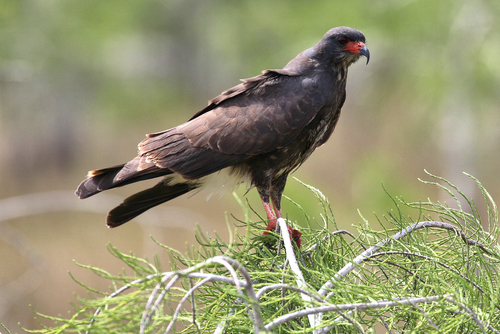
Snail Kite
Rostrhamus sociabilis
A master of the marsh, the Snail Kite is a stunning raptor with a bill perfectly engineered for its favorite delicacy: the apple snail. Found gliding over freshwater wetlands, these social hunters bring a touch of prehistoric elegance to the water's edge.
Quick Identification
Size
Length: 36–48 cm (14–19 in); Wingspan: 99–120 cm (39–47 in); Weight: 300–570 g (10–20 oz)
Colors
Adult males are charcoal or slate gray with bright red legs and facial skin; females and juveniles are dark brown with cream-streaked underparts.
Key Features
- Deeply curved, slender hook at the tip of the bill
- Broad, rounded wings and a square-tipped tail
- White band at the base of the tail visible in flight
- Bright orange-red legs and facial skin in adult males
When You’ll See Them
Behavior
The Snail Kite is a highly specialized raptor known for its sociable nature, often nesting in loose colonies and foraging in groups. Unlike many aggressive birds of prey, they are relatively docile and spend much of their time perched on low branches or reeds overlooking the water, searching for their specific prey. Their flight is slow and buoyant, characterized by heavy wingbeats as they cruise low over marsh vegetation.
Because of their extreme diet specialization, their movements are nomadic; they will shift entire populations based on local water levels and snail availability. While they aren't common in traditional suburban backyards, they are becoming more frequent visitors to lakeside properties and canal-side gardens where native or invasive apple snails are present. They are generally tolerant of humans, provided their nesting sites are not disturbed.
EverydayEarth exclusive
Camera Tips
Capturing the Snail Kite on camera requires a strategic approach focused on their 'butcher shops'—the specific perches where they take snails to eat. Look for low-hanging branches, fence posts near water, or dead snags that have a pile of empty apple snail shells at the base. Mounting your AI-powered camera 4 to 6 feet high, angled slightly downward toward these perches, will give you the best chance of catching a kite in action as it extracts its meal. Ensure your camera has a fast trigger speed, as their landing and takeoff can be surprisingly quick despite their slow cruising flight.
Since these birds are almost always near water, positioning your camera near the edge of a marsh or a canal is essential. If you live on a waterfront property, look for areas with tall emergent vegetation like cattails or pickerelweed. Avoid placing the camera where it will be triggered by constant water movement or swaying reeds; instead, focus the 'detection zone' on a solid branch or a dock railing where the bird is likely to land. A side-on angle is preferable to a head-on view to capture the distinctive curve of their specialized beak.
While you cannot bait a Snail Kite with traditional birdseed, you can attract them indirectly by maintaining a healthy wetland environment that supports apple snails. In areas where the invasive Giant Apple Snail is present, kites are often more active and easier to spot. Early morning light is your best friend for photography, as the low sun highlights the iridescent slate feathers of the male and the intricate streaking of the female. Set your camera to burst mode to capture the moment they use their hooked bill to pull the snail from its shell—a behavior that is rarely seen up close!
Similar Species
Species that look similar or are commonly confused with Snail Kite.
Northern Harrier
Harriers have a distinct white rump patch and a more owl-like facial disk compared to the Kite's dark face.
Hook-billed Kite
Found in more forested habitats; has a much thicker, heavier bill and varied barring on the chest.
Mississippi Kite
Smaller with a much shorter, straighter bill and pointed wings, usually seen catching insects in the air.
Frequently Asked Questions
Record Snail Kite at your habitat
Connect a camera to start building your own species record — AI identifies every visitor automatically.