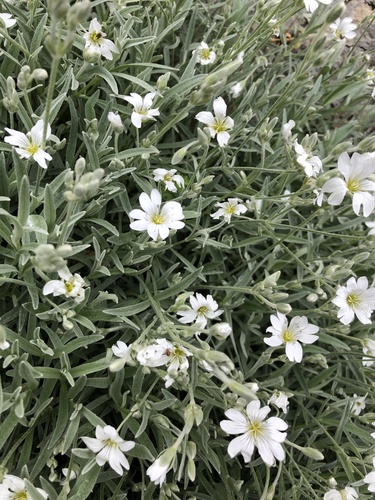
Snow-in-summer
Cerastium tomentosum
A shimmering carpet of silver and white, Snow-in-summer transforms rocky garden edges into a dramatic alpine landscape. This hardy perennial is a favorite for sun-drenched spaces and a magnet for backyard pollinators.
Quick Identification
Size
Height of 15-30 cm (6-12 in); spreads 60-90 cm (24-36 in) wide
Colors
Silvery-grey foliage with woolly textures; brilliant white flowers with small yellow centers
Key Features
- Silvery-grey, felt-like (tomentose) foliage
- Masses of star-shaped white flowers with notched petals
- Low-growing, mat-forming growth habit
- Evergreen to semi-evergreen leaves
When You’ll See Them
Behavior
Snow-in-summer is a vigorous, carpet-forming perennial that behaves like a living mulch. Native to the alpine regions of Italy, it is highly adapted to rocky, well-drained soils where it spreads quickly via runners to fill gaps. While it appears delicate, it is a tough survivor that thrives in the heat and sun, cascading over stone walls or garden edges like a literal drift of snow.
In the backyard ecosystem, it acts as a critical early-summer nectar source. It doesn't move on its own, but it interacts dynamically with the wind and local fauna. Because of its dense, woolly foliage, it provides excellent cover for ground-dwelling beneficial insects and small amphibians seeking a cool, damp microclimate during the heat of the day.
EverydayEarth exclusive
Camera Tips
Capturing Snow-in-summer with an AI camera is best approached as a study in macro-ecology or time-lapse photography. Because the plant is low-growing, place your camera on a mini-tripod or a ground stake just 6 to 10 inches off the earth. Angle the lens slightly upward if the plant is cascading over a rock or wall to capture the 'waterfall' effect of the white blooms against the silver foliage.
To see the true 'behavior' of this species, use a time-lapse setting. Program your camera to take a photo every 30 minutes during the peak blooming weeks of May and June. When played back, you’ll see the flowers opening to greet the sun and closing slightly as temperatures drop at night. This also provides a fascinating look at how the plant 'creeps' and expands its footprint over the course of a single growing season.
Because the flowers are a brilliant, reflective white, they can easily 'blow out' or overexpose in direct midday sun. If your camera allows for exposure compensation, drop it by -0.5 or -1.0 to retain the detail in the petals. Alternatively, position the camera to capture the plant during the 'Golden Hour'—shortly after sunrise or before sunset—when the soft light brings out the unique woolly texture of the silvery leaves.
Don't just focus on the plant itself; use the Snow-in-summer as a stage for pollinator activity. Set your AI camera to a high-sensitivity motion trigger with a short video duration (5-10 seconds). The bright white blooms are magnets for honeybees, hoverflies, and small butterflies. By focusing on a specific cluster of flowers, you can document the diverse range of insects that rely on this species for fuel.
Similar Species
Species that look similar or are commonly confused with Snow-in-summer.
Frequently Asked Questions
Record Snow-in-summer at your habitat
Connect a camera to start building your own species record — AI identifies every visitor automatically.