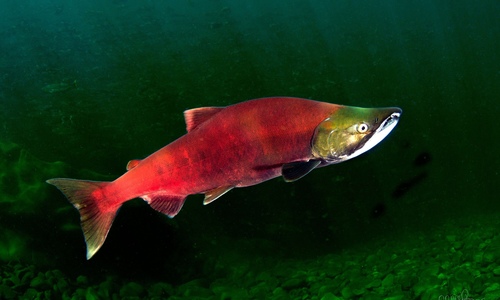
Sockeye Salmon
Oncorhynchus nerka
Witness one of nature's most spectacular migrations right in your local waterways. The Sockeye Salmon's dramatic transformation from silver ocean-dweller to scarlet river-warrior is a breathtaking display of endurance and instinct.
Quick Identification
Size
60–84 cm (24–33 in) in length; 2.3–7 kg (5–15 lb) in weight
Colors
In the ocean, they are silvery-blue with fine black speckling. During spawning, both sexes develop a brilliant scarlet-red body with an olive-green head and tail.
Key Features
- Vibrant red body with a distinct olive-green head during spawning
- Silvery-blue scales with no large spots on the back while in the ocean
- Hooked jaw (kype) and humped back developing in spawning males
- Average length of 2-3 feet and weight of 5-15 lbs
When You’ll See Them
Behavior
Sockeye Salmon are famous for their anadromous life cycle, meaning they hatch in freshwater, migrate to the Pacific Ocean to mature, and eventually return to their natal streams to spawn. This journey can cover thousands of miles and involves navigating complex river systems using an incredible sense of smell and magnetic orientation. Unlike many other salmon species that prefer insects or smaller fish, Sockeye are primarily planktivores, using their gill rakers to strain tiny organisms from the water.
Once they reach their home rivers to spawn, their behavior shifts dramatically. They stop eating entirely, focusing all their energy on reaching the gravel beds where they were born. Males become highly territorial and aggressive, competing for the chance to fertilize eggs, while females focus on digging 'redds' (nests) in the gravel. Because they are semelparous, they undergo a rapid physical transformation followed by death shortly after spawning, providing a massive nutrient boost to the surrounding forest ecosystem.
EverydayEarth exclusive
Camera Tips
Capturing Sockeye Salmon requires a different approach than traditional land-based wildlife. If your backyard includes a creek or river frontage during the spawning run, the best results come from an underwater 'trail cam' setup. Use a waterproof action camera or a trail camera in a dedicated marine housing. Secure the camera to a weighted base or a heavy stone and position it in shallow, fast-moving water where you see gravel on the bottom. These 'redds' are where the salmon congregate to lay eggs, ensuring you get high-activity footage of their vibrant red bodies.
Lighting and water clarity are your biggest challenges. Position your camera to face slightly downstream to avoid debris hitting the lens, and try to capture the early morning or late afternoon sun, which penetrates the water at an angle to highlight the salmon's brilliant red scales. If your camera is above water, use a circular polarizing filter on the lens to cut through the surface glare; without this, you'll often see nothing but reflections of the sky rather than the fish beneath.
Set your camera to video mode rather than still photos. The movement of the water and the salmon's iconic tail-flicking behavior are much more engaging in high-definition video. A high frame rate (at least 60fps) is recommended because salmon move with sudden, powerful bursts. Avoid using white-light flashes at night as this can spook the fish; instead, rely on the natural daylight of their most active diurnal hours for the most 'organic' look. Finally, check the water levels frequently, as a heavy rain can easily wash away a camera that isn't properly anchored.
Similar Species
Species that look similar or are commonly confused with Sockeye Salmon.
Coho Salmon
Coho have black spots on their backs and upper tail, and their spawning color is a darker, maroon-red rather than the bright scarlet of the Sockeye.
Chinook Salmon
Much larger than Sockeye, Chinooks have a dark 'gum line' in their mouths and are covered in small black spots across their entire back and tail.
Frequently Asked Questions
Record Sockeye Salmon at your habitat
Connect a camera to start building your own species record — AI identifies every visitor automatically.