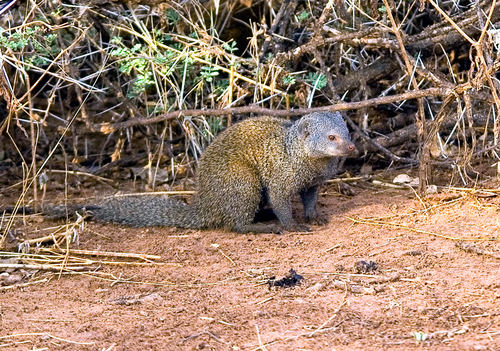
Somali Dwarf Mongoose
Helogale hirtula
The Somali Dwarf Mongoose is a miniature marvel of the East African drylands, proving that big personality comes in small packages. These highly social hunters turn the desert floor into a coordinated team effort, patrolling their territory with unmatched curiosity.
Quick Identification
Size
Total length 20-27 cm (8-10.6 in); tail 15-18 cm (5.9-7 in); weight 220-350g (7.8-12.3 oz)
Colors
Grizzled grayish-brown to tawny fur with a salt-and-pepper appearance; underparts are typically paler buff or yellowish; no significant color difference between males and females.
Key Features
- Smallest African carnivore
- Grizzled, salt-and-pepper fur texture
- Short, pointed muzzle with small rounded ears
- Social groups often seen traveling together
When You’ll See Them
Behavior
The Somali Dwarf Mongoose is a highly social and cooperative species, living in tightly-knit groups that usually range from 4 to 15 individuals. Unlike many other small carnivores, they are strictly diurnal, making them a favorite for daytime observers. Their social structure is matriarchal, led by a dominant female, with the entire group participating in the care and protection of the young.
These mongooses are famous for their mutualistic relationship with certain hornbill species; the birds act as lookouts for predators while the mongooses flush out insects. Within the group, they utilize a sophisticated system of vocalizations to signal danger, coordinate movement, and maintain social bonds. They are territorial and spend much of their day foraging or basking near their dens, which are often repurposed termite mounds or rock crevices.
EverydayEarth exclusive
Camera Tips
To capture the Somali Dwarf Mongoose on camera, you must think small and low. Because these mammals stand only a few inches off the ground, your camera should be mounted no higher than 15 to 20 centimeters (6 to 8 inches). Aiming the lens parallel to the ground or slightly upward will provide an intimate, eye-level perspective of their social interactions. Look for 'hotspots' such as active or abandoned termite mounds, which serve as their primary dens and lookout posts; a camera positioned facing a mound entrance is almost guaranteed to capture group departures in the morning.
Because they are small and fast-moving, set your camera to a high trigger speed (0.2 seconds or faster if possible) and use a 'Burst' or 'Multi-shot' mode. This ensures you catch the entire group as they follow one another in a line, rather than just the tail of the last individual. If your camera allows for video, 10–20 second clips are ideal for capturing their fascinating vocalizations and grooming behaviors, which are much more descriptive than still images.
In backyard or lodge settings in East Africa, these mongooses are attracted to small, shallow water features. Placing a camera near a low-profile birdbath or a leaking pipe in an arid area can yield excellent results, especially during the heat of midday. Avoid using heavy baits; instead, focus on natural corridors like the base of rock piles or gaps in garden fences where they feel secure from avian predators. During the dry season, the addition of a small amount of moisture to the soil can attract the insects they hunt, keeping them in front of your lens for longer periods.
Similar Species
Species that look similar or are commonly confused with Somali Dwarf Mongoose.
Frequently Asked Questions
Record Somali Dwarf Mongoose at your habitat
Connect a camera to start building your own species record — AI identifies every visitor automatically.