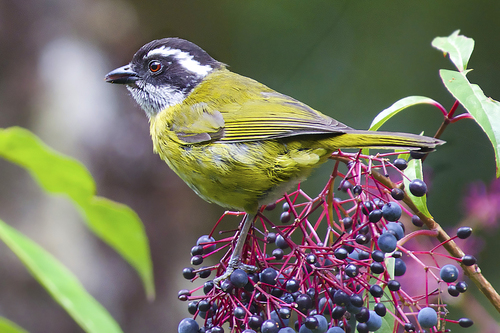
Sooty-capped Chlorospingus
Chlorospingus pileatus
A charismatic leader of the highland cloud forests, the Sooty-capped Chlorospingus is instantly recognizable by its bold white 'eyebrow' and social personality. Endemic to the mountains of Costa Rica and Panama, these lively birds are a favorite for backyard birders and camera trappers alike.
Quick Identification
Size
Length: 13–14 cm (5.1–5.5 inches); Weight: 18–22 g (0.6–0.8 oz)
Colors
Features a matte black crown and face with a stark white stripe behind the eye; the back is olive-green, the throat is white, and the breast is a bright yellow-green. Males and females are identical in plumage.
Key Features
- Sooty black head with a bold white post-ocular stripe
- Bright yellow-green breast band
- Contrasting white throat and belly
- Small, stubby black bill
When You’ll See Them
Behavior
The Sooty-capped Chlorospingus is an exceptionally social and energetic bird, rarely seen alone. They are famous for being the 'sentinels' or leaders of mixed-species foraging flocks in the highlands. If you see a group of birds moving through the trees, this species is often at the center of the activity, calling out to keep the group together. They move with a restless, hopping motion, constantly scanning leaves for insects or looking for ripe berries.
Unlike many shy forest birds, these chlorospinguses are quite bold around human habitation, provided there is enough cover. They are frequent visitors to highland gardens and eco-lodges, where they show little fear of observers. Their vocalizations are a series of high-pitched, squeaky 'tsit' notes that can become quite loud when a flock is excited or defending a food source.
EverydayEarth exclusive
Camera Tips
To capture the Sooty-capped Chlorospingus, your camera placement is everything. These birds are most active in the 'mid-story'—the zone between ground level and the high canopy. Position your camera between 4 and 6 feet high, ideally mounted on a fence post or a sturdy branch near flowering shrubs like fuchsias or berry-producing bushes. Because they move in fast-paced groups, set your camera to 'Burst Mode' or a high-frame-rate video setting (at least 60fps) to catch their quick, twitchy movements without blur.
If you are trying to attract them to a specific spot for a clear shot, water is your best friend. In the misty highlands of Costa Rica and Panama, these birds are avid bathers. A shallow, elevated bird bath with a small solar dripper or fountain will almost guarantee a visit. The sound of moving water acts as a magnet for the entire flock. Place the camera about 3-5 feet from the water source, angled slightly downward to capture the reflections and the splashing action.
For baiting, while they are primarily insect-eaters, they have a massive sweet tooth for fruit. A platform feeder stocked with overripe bananas or plantain slices will often bring a whole family group in front of the lens. Try to hide the feeder behind natural moss or lichen-covered branches to give your photos a more 'wild' look. Since these birds live in cloud forests where light can be dim, ensure your camera's ISO is set to auto or slightly higher to compensate for the misty, overcast conditions common in their habitat.
Lastly, consider the weatherproofing of your setup. The highlands are notoriously damp. Use a protective housing or a small 'roof' over your camera to prevent water droplets from blurring the lens. During the breeding season (March–May), look for them carrying nesting material like moss and rootlets; if you spot a frequent flight path, that’s the perfect place to set up a trail cam for intimate behavioral footage.
Similar Species
Species that look similar or are commonly confused with Sooty-capped Chlorospingus.
Common Chlorospingus
Has a brownish head rather than black, and lacks the long white post-ocular stripe, typically showing only a small white spot behind the eye.
Yellow-throated Chlorospingus
Found at lower elevations and features a bright yellow throat, whereas the Sooty-capped has a distinctly white throat.
Frequently Asked Questions
Record Sooty-capped Chlorospingus at your habitat
Connect a camera to start building your own species record — AI identifies every visitor automatically.