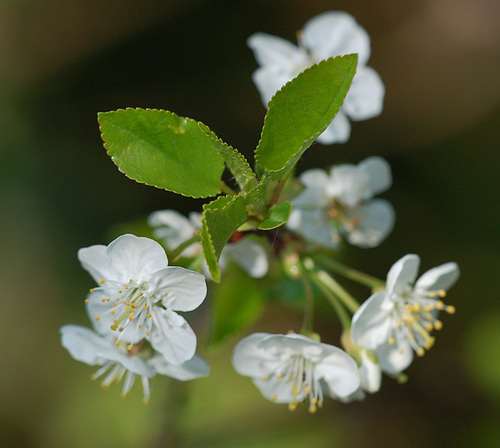
Sour Cherry
Prunus cerasus
A burst of springtime white followed by a summer of crimson, the Sour Cherry is a backyard powerhouse that sustains pollinators and songbirds alike.
Quick Identification
Size
Small to medium tree reaching 4–10 m (13–33 ft) in height; trunk diameter up to 30 cm (12 in).
Colors
Glossy dark green leaves; snow-white blossoms; fruit ranges from bright scarlet (Amarelle) to deep mahogany (Morello).
Key Features
- Compact, bushy growth habit
- White five-petaled flowers appearing with or before leaves
- Small, serrated, oval leaves
- Tart, juicy red drupes (cherries) with a central stone
When You’ll See Them
Geographic range
Where Does the Sour Cherry Live?
The Sour Cherry finds its ancient roots in the sprawling landscapes of Eastern Europe and Southwest Asia, spanning from the Balkans across to the Caucasus and northern Iran. Today, this resilient tree has established itself across the temperate reaches of the Northern Hemisphere, flourishing in orchards and gardens throughout the United States, Canada, and much of mainland Europe. Whether found in a tidy suburban backyard or naturalized along a sunny forest edge, these trees are a staple of temperate climates worldwide.
Basemap © OpenStreetMap contributors
Behavior
While the Sour Cherry tree itself remains rooted, it exhibits a distinct seasonal rhythm that dictates the activity of surrounding wildlife. In early spring, the tree undergoes a dramatic blooming phase, producing masses of white flowers that serve as a critical early-season nectar source for bees, hoverflies, and other pollinators. This burst of floral activity is a short but intense period of biological production that marks the start of the growing season.
As the flowers fade and the fruit develops throughout the summer, the tree becomes a focal point for avian activity. Unlike sweet cherries, sour cherries contain higher levels of acidity, yet they are highly sought after by various bird species. The tree interacts with humans primarily as a cultivated crop, often requiring protection from birds if a harvest is desired. In the wild or in naturalized suburban settings, it acts as a keystone resource, providing high-energy food during the peak of summer nesting and fledgling seasons.
EverydayEarth exclusive
Camera Tips
To capture the full lifecycle of a Sour Cherry tree, use a combination of time-lapse and motion-trigger settings. For the spring blossom phase, mount your camera on a stable post or nearby structure about 5–7 feet high, angled slightly downward toward a cluster of flowers. This position is ideal for capturing the fast-moving pollinators like honeybees and mason bees that visit the blooms. Use a high shutter speed and macro settings if your camera allows, as the movement of bees is incredibly rapid.
Once the fruit begins to ripen, shift your camera's focus to the outer canopy where the cherries are most visible. This is the prime time to record bird behavior. Position the camera about 2–3 feet away from a fruit-heavy branch. You’ll likely capture species like American Robins, Cedar Waxwings, and European Starlings. Since birds are easily spooked, ensure the camera is well-camouflaged with leaf-patterned housing or tucked behind foliage to get the most natural feeding footage.
Don't forget the ground activity. As ripe cherries fall, they attract a variety of mammals. Place a second camera at a low angle (about 12 inches off the ground) near the base of the trunk. This is an excellent way to see nocturnal visitors such as raccoons, opossums, or even foxes that scavenge the fallen fruit at night. Ensure your infrared flash is enabled for these nighttime foragers.
For a truly professional result, try a long-term time-lapse. Set your camera to take one photo every 6 hours from late March through July. When compiled, this reveals the stunning transition from bare branches to white clouds of blossoms, followed by the emergence of green leaves and the final reddening of the fruit. This provides a unique perspective on the tree's development that motion-triggering alone cannot capture.
Similar Species
Species that look similar or are commonly confused with Sour Cherry.
Frequently Asked Questions
Record Sour Cherry at your habitat
Connect a camera to start building your own species record — AI identifies every visitor automatically.