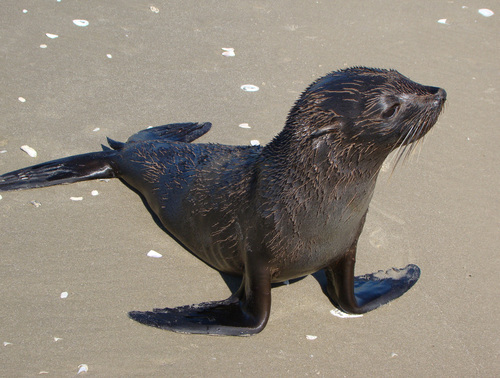
South American Fur Seal
Arctocephalus australis
A master of both the crashing surf and the jagged cliffside, the South American Fur Seal is a social icon of the Southern Hemisphere. With their plush coats and expressive, dog-like faces, these 'eared seals' are a highlight for any coastal wildlife enthusiast.
Quick Identification
Size
Males reach 1.5–2 m (5–6.5 ft) and up to 200 kg (440 lbs); Females are smaller at 1.3–1.5 m (4.3–4.9 ft) and 30–60 kg (66–132 lbs).
Colors
Dark greyish-brown to blackish fur, often appearing lighter on the underside; adult males develop a thick, grizzly mane of longer hair.
Key Features
- Pointed, dog-like snout with long whiskers
- Small but visible external ear flaps
- Thick, double-layered fur coat
- Robust flippers capable of rotating forward for 'walking' on land
When You’ll See Them
Behavior
South American Fur Seals are highly social and energetic marine mammals known for their agility both in the ocean and on rugged coastal terrain. Unlike 'true' seals, they possess the ability to rotate their hind flippers forward, allowing them to gallop across rocky shores with surprising speed. They spend a significant portion of their lives at sea but congregate in massive, vocal colonies on secluded islands and rocky ledges to rest, molt, and breed.
Their social structure becomes particularly intense during the breeding season, when dominant males establish territories through guttural vocalizations and physical displays. They are primarily nocturnal hunters, which allows them to avoid some daytime predators and take advantage of prey that migrates toward the surface at night. While generally wary of humans, they are inquisitive in the water and can often be seen 'rafting'—floating on their sides with a flipper in the air to regulate their body temperature.
EverydayEarth exclusive
Camera Tips
To capture high-quality footage of South American Fur Seals, focus your efforts on 'haul-out' sites—the specific rocky ledges or sheltered beaches where they come to rest between hunting trips. Because these animals are most active in the water at night, your best opportunity for clear, detailed images is during the day while they are sunbathing. Mount your camera on a stable tripod or a rock-weighted mount to combat high coastal winds, positioning it at a height of about 2 to 3 feet to get an eye-level perspective of the seals as they lounge.
Lighting is a major challenge in coastal environments. The contrast between dark fur and reflective white sea foam can easily 'trick' a camera's sensor. Set your exposure compensation to -0.7 or -1.0 to ensure you don't lose the fine texture of their dark coats to overexposure. Use a fast shutter speed (at least 1/500s) if you are capturing stills, as their movements on land are jerky and quick, especially during social squabbles. If your camera supports it, high-dynamic-range (HDR) video settings can help balance the bright ocean background with the dark foreground subjects.
For the best results, look for 'polishing' on the rocks—smooth, dark areas where seals have repeatedly dragged their bodies; these are their preferred paths and resting spots. During the breeding season from October to December, the colonies are bustling with activity, providing the best chance to record vocalizations and territorial behavior. Always use a long-range lens or position your camera at least 50 feet away using a PIR (Passive Infrared) sensor set to 'Medium' sensitivity. This prevents the camera from being triggered by every passing wave while still capturing the heat signature of a large mammal.
Similar Species
Species that look similar or are commonly confused with South American Fur Seal.
Frequently Asked Questions
Record South American Fur Seal at your habitat
Connect a camera to start building your own species record — AI identifies every visitor automatically.