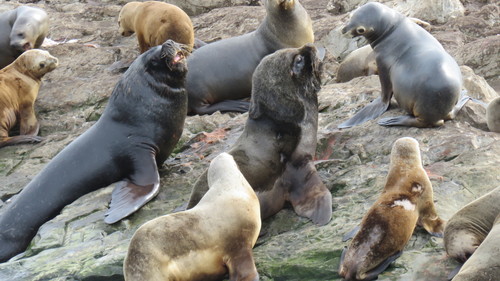
South American Sea Lion
Otaria flavescens
Meet the 'Lion of the Sea,' a majestic coastal giant known for its golden mane and thunderous roar. Whether lounging on Patagonian cliffs or surfing the Pacific swells, these social mammals are the true kings of the South American shoreline.
Quick Identification
Size
Males reach 2.7 m (9 ft) and weigh up to 350 kg (770 lb); females are smaller, reaching 2 m (6.5 ft) and 150 kg (330 lb).
Colors
Adult males are dark brown with a distinctively lighter, golden-orange mane. Females and sub-adults are a lighter tan or yellowish-brown. Pups are born almost black.
Key Features
- Thick, lion-like mane on mature males
- Distinctly upturned, blunt snout
- Small but visible external ear flaps
- Large, paddle-like front flippers used to walk on land
When You’ll See Them
Sightings on EverydayEarth
Apr 21, 2026
A bustling scene at the coast where a large colony of Imperial Shags stands across the rocky terrain. Several Magellanic Penguins are interspersed within the group, waddling between the shags. In the background, South American Sea Lions are hauled out on the wet rocks as waves crash against the shore under a pale morning sky.
Apr 18, 2026
On the rocky shoreline of Isla Tovita, several Magellanic Penguins are seen waddling across the rocks near the water's edge. A large South American Sea Lion is resting on the rocks, occasionally lifting its head and shifting its weight as waves crash nearby. Smaller dark birds, likely shags, are also visible moving along the coast.
Apr 2, 2026
A group of Imperial Shags is scattered across a rocky nesting ground overlooking the ocean, some resting on raised mounds. In the water just offshore, several South American Sea Lions are visible swimming and bobbing in the surf as the waves crash against the rocks.
Apr 2, 2026
A South American Sea Lion is resting on the rocky terrain of the island. It remains largely still, occasionally turning its head to scan the surrounding area while waves crash against the shore in the background.
Apr 1, 2026
A vibrant coastal scene unfolds at an Imperial Shag colony on Isla Tova. Many shags are perched on their distinctive mud-mound nests across the rocky foreground. One shag flies low across the frame from left to right, while Kelp Gulls soar over the crashing blue waves in the distance. Near the shoreline, several South American Sea Lions rest on the rocks, enjoying the bright morning sun.
Mar 31, 2026
On the rocky shores of Isla Tova, a South American Sea Lion rests near the water, occasionally lifting and turning its head. A gull flies across the frame and lands on the rocks nearby. In the background, the vast white landscape indicates a large seabird colony under a bright, clear sky.
Behavior
In the water, they are graceful and acrobatic hunters, but on land, they appear more lumbering. However, they are surprisingly agile for their size, using their powerful front flippers to rotate their pelvis and walk on all fours rather than dragging their bodies like 'true' seals. While generally wary of humans in the wild, they have become highly accustomed to coastal ports where they scavenge for scraps near fishing vessels, sometimes showing a bold and curious temperament toward people.
EverydayEarth exclusive
Camera Tips
Capturing South American Sea Lions requires a strategy focused on durability and perspective. Since these animals frequent salt-heavy environments, use a protective housing or ensure your camera is rated for high humidity and salt spray. Mount your camera on a stable tripod or secure it to a rock crevice at a height of 3 to 5 feet. Avoid placing cameras directly on the sand where a 350kg male might accidentally crush it or cover the lens in debris during a territorial dispute. Angle the camera slightly downward to capture the full scale of the colony without losing the horizon.
Timing is everything for these marine mammals. While they are active in the water at night, they are best photographed during the day when they haul out to rest and socialize. The hours shortly after sunrise offer the best lighting for their wet fur, which can create harsh glares in midday sun. During the breeding season—mid-summer in the Southern Hemisphere—focus your lens on the edges of the colony where younger bachelor males often hang out, as they are more active and provide more dynamic motion-triggered shots than the sleeping harem-holders.
Technical settings should account for the slow but sudden movements of these animals. Use a fast shutter speed or a high-frame-rate video setting to capture barks and territorial displays without blur. Because beaches are wide-open spaces, passive infrared (PIR) sensors can be triggered by moving water or heat signatures from rocks; try to mask the bottom of your sensor to focus on the area where the sea lions actually walk. If your camera allows, use a time-lapse mode during peak hours to document the ebb and flow of the colony as the tide changes.
Similar Species
Species that look similar or are commonly confused with South American Sea Lion.
South American Fur Seal
Much smaller with a pointier snout and a thick, double-layered fur coat that looks 'plusher' than the sea lion's coat.
California Sea Lion
Found further north; males have a prominent 'sagittal crest' bump on their head rather than the thick, lion-like mane seen in the South American species.
Frequently Asked Questions
Record South American Sea Lion at your habitat
Connect a camera to start building your own species record — AI identifies every visitor automatically.