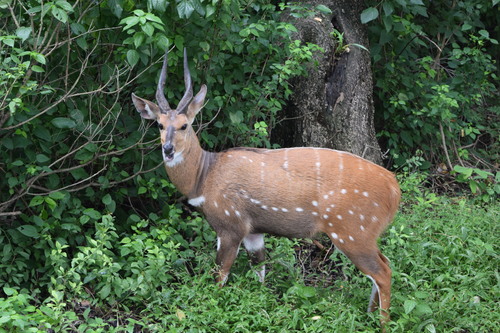
Southern Bushbuck
Tragelaphus sylvaticus
Elegant, elusive, and masterfully camouflaged, the Southern Bushbuck is the ultimate 'backyard' antelope. With its striking white spots and sharp spiral horns, capturing this forest-dweller on camera is a true mark of a successful wildlife watcher.
Quick Identification
Size
Shoulder height: 70–100 cm (28–39 in); Weight: 45–80 kg (100–175 lbs)
Colors
Rich reddish-brown to dark chocolate; white spots on the haunches, white 'bib' on the throat, and white bands on the legs.
Key Features
- Spiral horns in males, typically 25-35 cm long
- Distinctive white spots on the flanks and white throat patches
- High-rumped, hunched posture while walking
- Large, rounded ears with white interior markings
When You’ll See Them
Sightings on EverydayEarth
Jun 24, 2026
A Bushbuck stands alert on a rocky slope, looking away from the camera. It remains mostly still, occasionally twitching its ears while observing the surrounding woodland.
Jun 20, 2026
A pair of Vervet Monkeys move purposefully across the sandy, dry terrain in the foreground. In the background, a female Bushbuck grazes peacefully near the brush at the edge of the woodland.
Behavior
The Southern Bushbuck is a master of stealth, often referred to as the 'ghost of the forest.' Unlike many African antelope that congregate in large herds, the bushbuck is almost exclusively solitary, except when a female is with her calf or during brief mating encounters. They are highly territorial and possess a deep sense of 'home range,' often staying within a small area for their entire lives if food and cover are sufficient.
In suburban environments, they have become remarkably adept at living alongside humans, though they remain naturally wary. They are 'skulkers' rather than runners; when threatened, they prefer to freeze in place or lower their heads and slip quietly into the undergrowth. If cornered or startled, however, they can be surprisingly bold, emitting a loud, dog-like bark to warn others before making a quick retreat. They are also excellent swimmers and are known to take to water to escape predators.
EverydayEarth exclusive
Camera Tips
To successfully capture a Southern Bushbuck on camera, you must understand their preference for 'edge' habitats. They rarely cross open lawns during the day, so place your camera at the transition point where dense shrubbery meets a clearing or a garden path. Position the camera low—roughly 2 to 3 feet (60–90 cm) off the ground—to account for their hunched walking posture and to capture the intricate white markings on their legs and underbelly.
Lighting is your biggest challenge with this species. Because they are most active during dawn and dusk (crepuscular behavior), ensure your camera has a high-quality infrared sensor. We strongly recommend using 'No-Glow' or 'Black IR' cameras. Standard red-glow LEDs can sometimes startle a wary bushbuck, causing it to bark and flee, which results in a blurry image. Set your camera to 'Burst Mode' or 'Photo + Video' to capture the way they cautiously test the air before stepping into the open.
If you want to encourage them to linger in front of the lens, water is the best lure. A low-profile birdbath or a steady dripping tap in a quiet corner of the yard is irresistible to them, especially during the dry winter months. Unlike many other species, bushbuck are creatures of habit; if you catch one on camera at 6:15 AM on a Tuesday, there is a very high probability it will pass the same spot at roughly the same time the following day. Use this predictability to fine-tune your framing and capture that perfect 'hero' shot.
Similar Species
Species that look similar or are commonly confused with Southern Bushbuck.
Frequently Asked Questions
Record Southern Bushbuck at your habitat
Connect a camera to start building your own species record — AI identifies every visitor automatically.