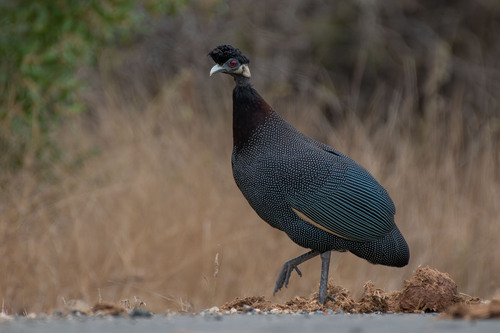
Southern Crested Guineafowl
Guttera edouardi
With its wild 'mohawk' of curly black feathers and striking spotted plumage, the Southern Crested Guineafowl is the punk-rocker of the African forest floor. Shier and more specialized than its common cousins, this elusive bird brings a touch of exotic mystery to any backyard camera setup.
Quick Identification
Size
Length: 45-50 cm (18-20 in); Weight: 0.7-1.5 kg (1.5-3.3 lbs)
Colors
Deep blue-black body plumage with fine white spots. The head features a distinctive curly black feather crest and lead-blue facial skin with a red throat patch.
Key Features
- Distinctive mop-like crest of curly black feathers
- Lead-blue facial skin with a bright red throat bib
- Dark plumage covered in uniform white spotting
- Robust, chicken-like body with a short, drooping tail
When You’ll See Them
Behavior
The Southern Crested Guineafowl is a social and somewhat secretive bird, particularly when compared to its more famous relative, the Helmeted Guineafowl. They typically move in small to medium-sized flocks known as coveys, numbering anywhere from 10 to 30 individuals. These birds are highly terrestrial, spending the vast majority of their day on the ground, where they move with a rhythmic, bobbing gait while scratching through the leaf litter for food. Despite their ground-dwelling nature, they are strong fliers over short distances and will take to the trees to roost at night or to escape immediate danger.
Communication is vital to the cohesion of the flock. They maintain a constant stream of soft chirps and contact calls while foraging to ensure no member of the group wanders too far into the jaws of a predator. While they are famously wary and will dash into thick cover at the first sign of a human or a dog, they can become quite habituated to quiet, established gardens that offer plenty of natural cover and a reliable water source. Their social interactions are fascinating to watch on camera, often involving subtle displays of dominance and playful chasing within the group.
EverydayEarth exclusive
Camera Tips
To capture high-quality footage of the Southern Crested Guineafowl, camera placement is the most important factor. Unlike many other ground birds that enjoy open spaces, this species feels most secure in the 'edge zone'—the transition between dense thickets and open clearings. Set your camera at a very low height, roughly 30 to 45 centimeters (12 to 18 inches) off the ground. This low angle not only provides an intimate, eye-level perspective but also ensures the camera’s motion sensor is triggered by their legs and lower body as they scratch through the brush.
While these birds are wild, they are highly motivated by food and water. If you are looking to attract them to a specific spot, a shallow ground-level birdbath is an excellent lure, especially in the drier months. If you use birdseed or cracked corn as a lure, try to scatter it under a thin layer of dried leaves or mulch rather than leaving it in a pile. This encourages the birds to engage in their natural scratching behavior, which makes for much more dynamic and interesting video clips. They are creatures of habit and will often follow the same foraging 'circuit' every day, so once you capture them on camera, keep the device in that location.
Because the Southern Crested Guineafowl is most active during the 'golden hours' of dawn and dusk, lighting can be a challenge. Ensure your camera is facing north or south to avoid the direct glare of the rising or setting sun, which can wash out the intricate white spotting on their feathers. Since they are quite skittish, use a 'No-Glow' or 'Black LED' infrared flash for nighttime or low-light shots. Standard red-glow LEDs can sometimes startle the flock, causing them to alarm-call and flee the area, potentially ruining future sighting opportunities.
Similar Species
Species that look similar or are commonly confused with Southern Crested Guineafowl.
Frequently Asked Questions
Record Southern Crested Guineafowl at your habitat
Connect a camera to start building your own species record — AI identifies every visitor automatically.