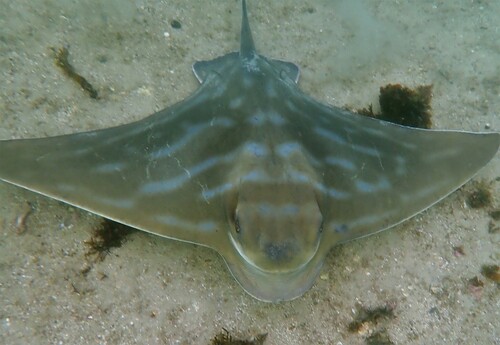
Southern Eagle Ray
Myliobatis tenuicaudata
Witness the 'birds of the sea' as they glide effortlessly through coastal shallows. With their shimmering blue-spotted wings and majestic leaps, the Southern Eagle Ray brings a touch of oceanic wonder to every shoreline.
Quick Identification
Size
Disc width up to 1.5m (4.9 ft); total length including tail up to 3m (9.8 ft); weight up to 50kg (110 lbs)
Colors
Olive-brown, bronze, or grey upper body with striking pale blue or grey spots and transverse bars; ventral (under) side is solid white.
Key Features
- Large, wing-like pectoral fins with pointed tips
- Prominent, rounded snout resembling a bird's beak
- Long, whip-like tail with a small dorsal fin and venomous spine at the base
- Upper body patterned with pale blue-grey spots or wavy lines
- Distinctive 'flying' swimming motion using flapping fins
When You’ll See Them
Behavior
Southern Eagle Rays are exceptionally graceful marine animals, often observed 'flying' through the water by flapping their powerful pectoral fins in a synchronized motion. Unlike many other ray species that spend the majority of their time camouflaged on the seafloor, Eagle Rays are active swimmers and are frequently seen cruising through the mid-water column or near the surface. They are highly social and often travel in large groups known as 'fevers,' which can consist of dozens of individuals moving in unison.
One of their most captivating behaviors is their tendency to leap completely out of the water, a feat known as breaching. While the exact reason for this remains a topic of scientific debate, it is widely believed to be a method for shaking off parasites, escaping predators, or communicating with the rest of the fever. In suburban coastal areas, they are known to be quite curious and will often glide under docks and piers, especially during high tide when they follow the rising water into estuaries to forage.
EverydayEarth exclusive
Camera Tips
Capturing the Southern Eagle Ray on camera requires a specialized approach since they are entirely aquatic. For coastal residents with 'waterfront backyards,' the best tool is a waterproof action camera or a submersible trail camera. To get the best footage, mount your camera to a pier piling or a weighted tripod about 1 to 2 feet above the sandy bottom. Position the lens to face a clearing between seagrass beds, as rays often frequent these open 'highways' to search for buried shellfish.
Lighting is the biggest hurdle for underwater wildlife photography. If you are not using a camera with a built-in sea-light, aim to record during the middle of the day or when the sun is directly overhead to allow maximum light penetration. The 'golden hour' can also produce stunning results in shallow water, as the angled light highlights the iridescent blue spots on the ray's back. Set your camera to a high frame rate (at least 60fps) to capture the fluid, bird-like motion of their wings without motion blur.
Timing your camera deployment is critical: consult a local tide chart and ensure your camera is active for the window starting two hours before peak high tide. This is the period when the rays move from deeper channels into the shallows of estuaries and backyard canals to feed. Because they are sensitive to electrical signals, ensure your camera housing is high-quality and well-shielded, as the 'hum' of some electronics can occasionally deter them or cause them to approach the lens with over-curiosity.
If you are filming from above the water—such as from a balcony or high dock—use a circular polarizing filter on your lens. This is a game-changer for backyard coastal monitoring as it cuts through the surface glare and reflections, allowing you to see the ray's distinctive patterns clearly through the water column. Avoid using bright artificial lights at night, as this can startle the rays and disrupt their natural foraging patterns.
Similar Species
Species that look similar or are commonly confused with Southern Eagle Ray.
Frequently Asked Questions
Record Southern Eagle Ray at your habitat
Connect a camera to start building your own species record — AI identifies every visitor automatically.