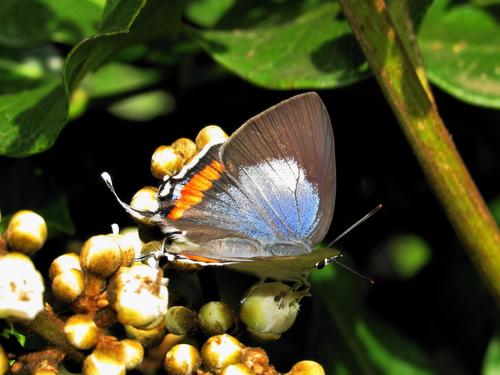
Southern Gossamer
Iolaus silas
The Southern Gossamer is a living jewel of the South African garden, sporting brilliant sapphire wings and a clever 'false head' to outsmart predators.
Quick Identification
Size
Wingspan of 32–40 mm (1.25–1.57 inches)
Colors
Males feature brilliant sapphire blue on the upperside with black tips; females are paler, often with white patches. Both sexes have a silky white underside with fine red and black lines.
Key Features
- Vivid sapphire blue upper wings
- Two delicate, hair-like tails on each hindwing
- Distinctive orange-red spots near the tail on the underside
- Sleek, silvery-white under-wing pattern
When You’ll See Them
Behavior
The Southern Gossamer, also known as the Southern Sapphire, is a fast-flying butterfly known for its energetic and erratic movement. It is often found darting around the canopy of trees, especially where mistletoe is present. Males are highly territorial and will select a prominent leaf or twig as a 'throne,' from which they launch intercept flights against any other insects that enter their airspace.
One of its most fascinating behaviors is the use of 'decoy' markings. When perched, the Southern Gossamer often twitches its hindwings. The long tails and bright red spots at the back of the wing mimic a head with moving antennae. This trick confuses predators like birds or spiders, directing their strikes toward the expendable wing edges rather than the butterfly's actual head, allowing the gossamer to escape with only a small notch missing from its wing.
EverydayEarth exclusive
Camera Tips
To capture the Southern Gossamer on camera, your best bet is to locate their nursery: mistletoe. Look for the distinctive clumps of parasitic mistletoe growing in Acacia or other garden trees. Position your camera at eye level with these clumps if possible, or focus on nearby flowering plants like Cape Honeysuckle (Tecoma capensis) or Plumbago, which are irresistible nectar sources that bring these high-flyers down to earth.
Because these butterflies move with lightning speed, use a camera with a fast trigger speed or high-frame-rate video capabilities. If you are using an AI-powered camera, ensure the 'Small Animal' or 'Insect' detection mode is active. Setting your camera to capture short video clips (10-15 seconds) is often more effective than still photos, as it allows you to see the subtle 'wing-twiching' behavior and the brilliant flash of blue when they take flight.
Lighting is critical for bringing out the 'sapphire' in their name. Try to angle your camera so the sun is behind it, illuminating the butterfly's upperside. Mid-morning light is ideal, as the butterflies are active but often pause to bask and warm their wings before the heat of the afternoon. If your camera has a macro setting, use it—the fine red lines on their white undersides are beautiful details that are easily lost in wide-angle shots.
For a more advanced setup, look for 'perching points.' Males often return to the same sunlit leaf at the end of a branch over and over again. Once you identify a favorite spot, mount your camera on a tripod or branch-clamp focused specifically on that leaf. This 'sit-and-wait' approach is the most reliable way to get a crisp, professional-quality image of this species.
Similar Species
Species that look similar or are commonly confused with Southern Gossamer.
Frequently Asked Questions
Record Southern Gossamer at your habitat
Connect a camera to start building your own species record — AI identifies every visitor automatically.