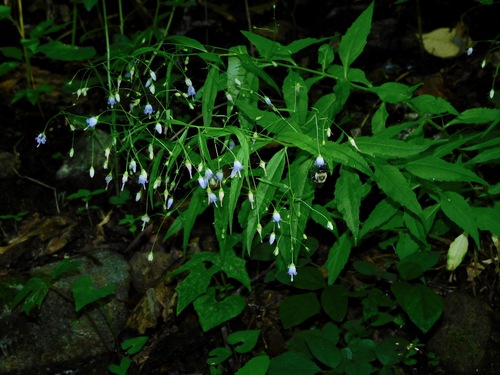
Southern Harebell
Campanula divaricata
A delicate mountain treasure, the Southern Harebell defies the rugged cliffs of the Appalachians with its airy, violet-blue blossoms and wiry grace.
Quick Identification
Size
Height ranges from 1 to 3 feet (30–90 cm); individual bell-shaped blossoms are approximately 0.25 inches (6 mm) long.
Colors
Flowers are pale blue to violet-blue; stems are green to reddish-brown; foliage is a deep, matte green.
Key Features
- Delicate, nodding bell-shaped flowers with recurved petals
- Long, distinctive style that protrudes significantly past the flower mouth
- Wiry, multi-branched stems that create a 'cloud' of blue
- Found primarily on rocky outcrops and acidic mountain slopes
When You’ll See Them
Behavior
While it may look fragile with its thread-like stems, this species is perfectly adapted to the wind-swept ridges of the Appalachian range. It remains dormant through the winter and begins its ascent in the spring, eventually blooming in the height of the summer heat. It is a vital resource for specialized pollinators who can navigate its downward-facing bells, providing nectar when many other spring ephemerals have long since gone to seed.
EverydayEarth exclusive
Camera Tips
Capturing the Southern Harebell requires a focus on stability and macro-detail. Because these flowers grow on incredibly thin, wiry stems, even a light breeze will cause them to sway significantly. To get a sharp image on your trail or backyard camera, place the unit on a tripod rather than a swaying branch. If your camera allows for shutter speed adjustments, use a higher speed to freeze the motion of the 'nodding' bells. Positioning the camera at a low angle, looking upward, can highlight the way the style protrudes from the flower, which is a key identification feature.
Since this species thrives on rocky outcrops, use the natural terrain to your advantage. If you are planting these in a backyard rock garden, place your camera roughly 12 to 18 inches from the blooms. This distance is the 'sweet spot' for most AI-powered cameras to trigger on the movement of visiting pollinators like sweat bees or hummingbirds. Avoid using heavy baits or lures that might weigh down the delicate stems; instead, ensure the background is dark or out of focus to make the pale blue bells 'pop' in the frame.
Time-lapse mode is particularly effective for the Southern Harebell. Set your camera to take a photo every 30 minutes during the peak of July. This will allow you to see the dramatic way the plant leans toward the sun and how the many buds on a single stalk open in succession. For the best lighting, aim for the 'golden hour'—shortly after sunrise or before sunset—as the thin petals of the harebell are somewhat translucent and glow beautifully when backlit by the sun.
Similar Species
Species that look similar or are commonly confused with Southern Harebell.
Frequently Asked Questions
Record Southern Harebell at your habitat
Connect a camera to start building your own species record — AI identifies every visitor automatically.