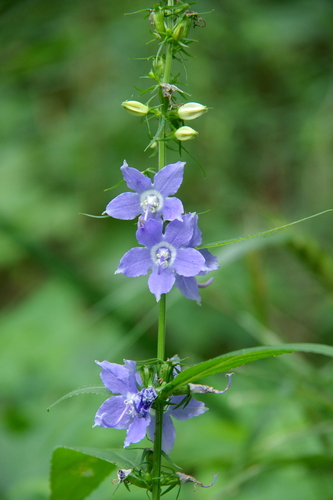
tall bellflower
Campanulastrum americanum
A towering spire of violet stars, the tall bellflower is a summer masterpiece that bridges the gap between wild woodland and the backyard garden.
Quick Identification
Size
3 to 6 feet (0.9 to 1.8 meters) in height; flowers are roughly 1 inch (2.5 cm) wide.
Colors
Light blue to violet-purple petals with a distinct white ring at the center and a long, pale-lavender style.
Key Features
- Tall, unbranched central stem with a spire of star-shaped flowers
- Deeply five-lobed petals that spread flat rather than forming a bell shape
- Prominent curved white style (the female reproductive part) protruding from the center
- Alternate, lance-shaped leaves with finely serrated edges
When You’ll See Them
Behavior
The tall bellflower is a fascinating study in botanical flexibility. Depending on when its seeds germinate, it can act as either an annual or a biennial. Seeds that sprout in the autumn will overwinter as a small rosette of leaves and bloom the following summer (biennial), while those that germinate in the spring will grow and flower in a single season (annual). This strategy ensures the species can survive varying climatic conditions year to year.
Unlike many other bellflowers that have drooping, bell-shaped blossoms, the tall bellflower's petals spread wide and flat, making it a favorite landing pad for heavy-bodied pollinators. It uses a clever reproductive mechanism called protandry, where the male parts of the flower release pollen before the female parts are ready to receive it. This encourages cross-pollination by insects moving from plant to plant rather than self-fertilization within the same flower.
EverydayEarth exclusive
Camera Tips
To capture the best images of tall bellflower, position your camera on a stake or tripod at mid-stem height, roughly 3 to 4 feet off the ground. Because these plants are quite tall and slender, they are prone to swaying in the breeze, which can trigger some AI cameras unnecessarily. To counter this, use a faster shutter speed if your device allows it, or place the camera slightly further back to keep the entire flowering spike in the frame without the motion-blur becoming a distraction.
Since tall bellflower is a magnet for large bees and butterflies, this is a prime opportunity to use your camera's 'motion-capture' or 'video' mode rather than just time-lapse. Focus your lens on the middle section of the flower spike where the most blossoms are open simultaneously. The long, curved style of the flower makes for a dramatic focal point, especially when a bumblebee is hanging from it to collect nectar.
For the best lighting, avoid direct midday sun which can wash out the delicate violet-blue hues of the petals. Instead, aim for the 'golden hours' of early morning or late afternoon when the light is softer and filtered through the tree canopy. If you are using an AI-powered camera like those featured on EverydayEarth, try setting a frequent interval during the morning hours to catch the daily opening of new buds as they bloom from the bottom of the spike upward.
Similar Species
Species that look similar or are commonly confused with tall bellflower.
Creeping Bellflower
An invasive species with nodding, bell-shaped flowers that grow primarily on one side of the stalk, unlike the star-shaped, radial flowers of the tall bellflower.
Great Blue Lobelia
Features tubular, two-lipped flowers in a similar blue color, but lacks the flat, five-pointed star shape of the bellflower.
Frequently Asked Questions
Record tall bellflower at your habitat
Connect a camera to start building your own species record — AI identifies every visitor automatically.