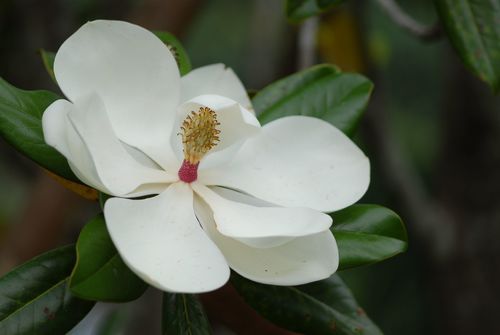
southern magnolia
Magnolia grandiflora
The Southern Magnolia is the undisputed queen of the Southern forest, boasting giant, lemon-scented blooms and glossy evergreen leaves that provide year-round majesty.
Quick Identification
Size
20–27.5 meters (60–90 feet) tall, with a canopy spread of 9–15 meters (30–50 feet)
Colors
Glossy dark-green upper leaves, rusty-bronze or brown fuzzy undersides, and creamy-white flowers
Key Features
- Massive white flowers up to 30 cm (12 in) wide with a lemon scent
- Thick, leathery evergreen leaves with a waxy sheen
- Large, cone-like fruit (follicles) with bright red seeds
- Dense, pyramidal to rounded growth habit
When You’ll See Them
Behavior
The Southern Magnolia is a slow-growing but incredibly resilient evergreen that functions as a cornerstone of the Southeastern ecosystem. Unlike many deciduous trees, it retains its thick, waxy foliage year-round, shedding older leaves intermittently which creates a heavy, natural mulch layer beneath its canopy. Its flowering behavior is a highlight of the late spring; the giant blossoms open in the morning and close at night, typically lasting only a few days before the petals drop.
Ecologically, the Southern Magnolia is fascinating because it is an ancient genus that evolved before bees existed. As a result, its flowers are designed to be pollinated by beetles. The tree provides dense cover for birds and small mammals throughout the winter, and its high-fat red seeds are a critical energy source for wildlife preparing for migration or winter dormancy.
EverydayEarth exclusive
Camera Tips
To capture the true beauty of a Southern Magnolia, focus your camera on the fruit rather than just the flowers. In the late summer and early autumn, the tree produces 'cones' that burst open to reveal oily, bright red seeds. Position your camera on a nearby branch or a tripod at eye-level with these seed clusters. Because these seeds are highly prized by Northern Cardinals, Tufted Titmice, and Wood Thrushes, you are almost guaranteed high-quality bird photography during the morning feeding hours.
For those interested in the blooming process, use a time-lapse setting. The massive white flowers undergo a dramatic opening sequence. Secure your camera to a sturdy branch facing a large bud that is just beginning to show its white petals. Set the interval to one photo every 10 minutes over a 48-hour period. Ensure your camera is shielded from direct midday sun to prevent the white petals from 'blowing out' or overexposing in your images.
Don't overlook the base of the tree. The dense canopy and heavy leaf litter make the area beneath a Southern Magnolia a favorite hiding spot for ground-foraging birds like Eastern Towhees and even small mammals like opossums. Placing a camera near the trunk at a low angle can capture unique 'under-canopy' behaviors that occur in the shade. Use a high-sensitivity trigger setting, as the lighting under the thick leaves can be quite dim even during the day.
Similar Species
Species that look similar or are commonly confused with southern magnolia.
Frequently Asked Questions
Record southern magnolia at your habitat
Connect a camera to start building your own species record — AI identifies every visitor automatically.