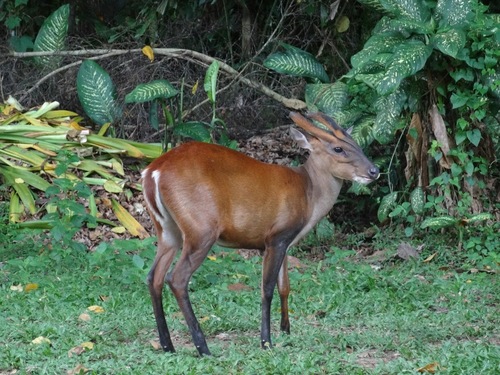
Southern Red Muntjac
Muntiacus muntjak
Known as the 'Barking Deer' for its deep, dog-like alarm call, the Southern Red Muntjac is a primitive and fascinating deer species. With its unique tusks and secretive nature, it is a master of the forest undergrowth.
Quick Identification
Size
Shoulder height: 40–65 cm (16–26 in); Weight: 15–35 kg (33–77 lbs)
Colors
Deep reddish-brown to chestnut coat; creamy-white underparts and underside of tail; males feature dark 'V' shaped facial markings
Key Features
- Small, downward-curving antlers on long bony pedicels
- Protruding canine tusks in males used for defense
- Distinctive 'hunched' posture with hindquarters higher than shoulders
- Large, visible suborbital scent glands below the eyes
When You’ll See Them
Behavior
The Southern Red Muntjac, often called the 'Barking Deer,' is a solitary and secretive creature that relies on the dense cover of vegetation to stay hidden. They are highly territorial, with both males and females using their large preorbital scent glands to mark twigs and branches within their home range. When they feel threatened or sense a predator, they emit a deep, resonant bark that can continue for many minutes, serving as a warning to others in the area.
In social settings, they are rarely seen in groups larger than a mother and her fawn. They are surprisingly brave for their size; while they prefer to flee, males are known to use their sharp canine tusks rather than their antlers when defending their territory from rivals. Their interaction with humans is usually characterized by extreme shyness, though they frequently visit gardens that border forest reserves to snack on ornamental plants and fallen fruit.
EverydayEarth exclusive
Camera Tips
To capture the Southern Red Muntjac, camera placement is critical because of their small stature. Mount your camera no higher than 12 to 18 inches off the ground. If the camera is tilted downward from a higher post, you risk losing the detail of their unique facial markings or the tusks of the males. Aim the lens toward 'game trails'—the narrow, flattened paths through tall grass or brush that these deer use to move between cover and feeding areas.
Muntjacs are highly attracted to fallen fruit, particularly wild mango, figs, or even fallen orchard fruit like jackfruit or apples. If you have a fruiting tree in your backyard, point your camera there. They are also known to frequent mineral licks; in a garden setting, a simple salt block placed in a quiet, shaded corner can be a powerful lure that keeps them in front of the lens for several minutes rather than just a quick walk-by.
Because they are most active during the low-light hours of dawn and dusk, ensure your camera has a high-quality infrared flash to avoid 'white-out' on their reflective coat. Set your device to 'Hybrid Mode'—capturing a high-resolution photo followed by a 15-second video clip. This is the best way to record their distinctive barking sound, which is one of the most rewarding 'finds' for any backyard researcher. During the rainy season, look for them in more open clearings as they emerge to dry off and feed on new growth.
Similar Species
Species that look similar or are commonly confused with Southern Red Muntjac.
Frequently Asked Questions
Record Southern Red Muntjac at your habitat
Connect a camera to start building your own species record — AI identifies every visitor automatically.